












If your BMW, Audi, or VW suddenly stumbles at a red light, shudders on the on-ramp, or throws a check-engine light that starts flashing, one of the first things a good European technician suspects is the ignition coils. Learning to read ignition coil symptoms early can be the difference between a quick pack replacement and a damaged catalytic converter. On modern turbocharged engines, these small coil-on-plug units live in one of the hottest, most demanding spots under the hood.
Jacksonville makes the job harder. Our summers routinely push under-hood temperatures well past what these plastic-bodied coils were designed to shrug off, and heat is the number-one enemy of ignition components. That is exactly why so many local BMW, Audi, and VW owners see coil-related misfires cluster during the hottest stretch of the year.

This guide walks through what an ignition coil actually does, the bad ignition coil symptoms to watch for, why our Florida climate accelerates coil-pack failure, and how a proper diagnosis beats throwing parts at the problem.
Quick answer: Ignition coil symptoms show up as a rough idle, a shaking or hesitating engine, reduced power or limp mode, and a check-engine light (sometimes flashing) driven by cylinder misfire codes P0300 through P0306.
- Coil-on-plug packs are the most common misfire cause on turbo BMW, Audi, and VW engines.
- Florida under-hood heat cooks coils and makes them fail in clusters, often several at once.
- A flashing check-engine light means an active misfire that can destroy the catalytic converter, so stop driving.
- Proper diagnosis isolates the exact failing cylinder before any part is replaced.
What an Ignition Coil Actually Does on a Turbo Engine
An ignition coil is a compact transformer. It takes your car’s 12-volt electrical supply and steps it up to tens of thousands of volts, enough to jump the spark plug gap and ignite the compressed air-fuel mixture at exactly the right instant. On older engines a single coil fed several plugs through wires. Nearly every modern European turbo engine instead uses a coil-on-plug design: one dedicated coil sits directly on top of each spark plug.
That layout is precise and efficient, but it puts each coil in a brutal environment:
- Heat. The coil bolts to the cylinder head and sits inches from a turbocharger that can glow. Engine bay temperatures build fast and stay high.
- Vibration. Turbo engines make big torque, and constant vibration fatigues the coil’s internal windings and connectors.
- Pressure. Forced induction packs more air into each cylinder, so the coil has to push a hotter, stronger spark than a naturally aspirated engine ever demanded.
When a coil weakens, the spark it delivers becomes inconsistent. The cylinder it feeds starts to misfire, and that is when the symptoms begin.
Ignition Coil Symptoms: The Warning Signs to Watch
Most drivers notice something feels off before they ever see a code. The classic ignition coil symptoms build gradually, then get worse under load. Here is what a failing coil typically feels like from the driver’s seat:
- Rough idle. The engine shakes or feels lumpy at a stop, sometimes rocking the whole car. A rough idle is one of the earliest and most common signs.
- Engine misfire symptoms. A stumble, jerk, or hesitation, especially when you accelerate or climb an on-ramp under boost.
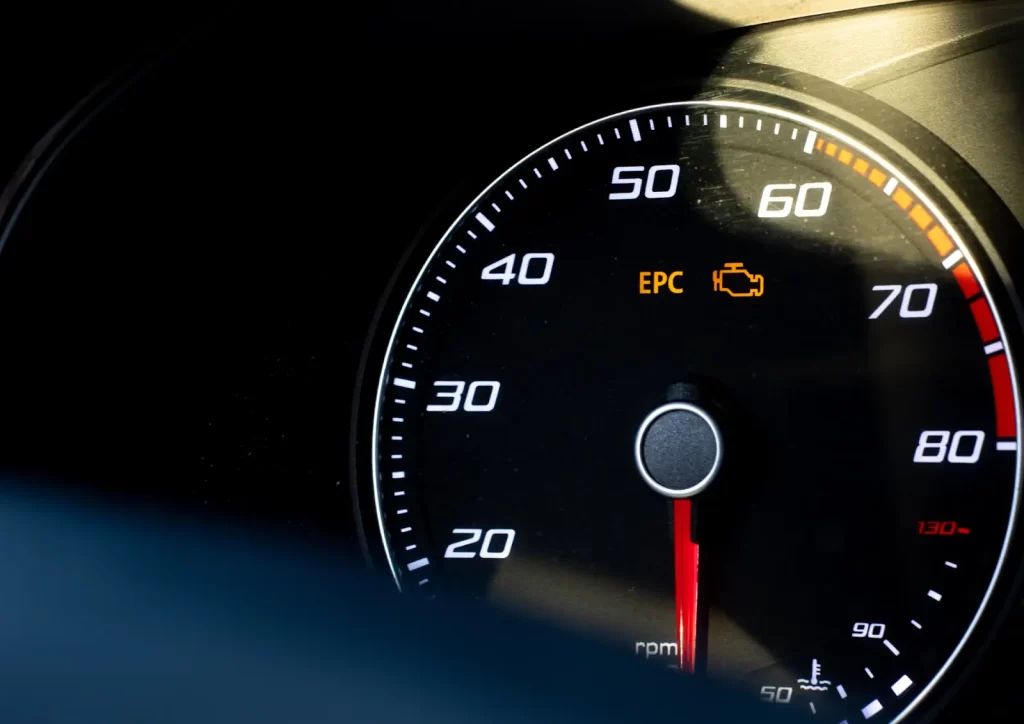
- Check-engine light. A steady light points to a stored fault; a flashing light means an active, damaging misfire is happening right now.
- Reduced power or limp mode. The car pulls its own timing and boost to protect itself, leaving you sluggish or capped at low RPM.
- Hesitation on throttle. A pause or “hole” in acceleration before power comes back.
- Poor fuel economy. Unburned fuel from a dead cylinder means the engine works harder for less.
- Hard starting. A weak coil can make the engine crank longer or fire unevenly on a hot restart.
A BMW misfire in particular tends to announce itself as a shudder you can feel through the seat, followed by a triangle-with-exclamation warning or a wrench light. Because BMW, Audi, and VW share so much coil design across platforms, the same story repeats across the brands we service.
Symptom-to-Cause Table: What Each Sign Usually Means
Symptoms overlap, so no single sign is a guaranteed diagnosis. This table shows the most likely cause behind each common complaint on a turbo European engine:
| What you notice | Most likely cause | What it means |
|---|---|---|
| Rough idle that smooths out at speed | Failing ignition coil or spark plug | One cylinder is misfiring at low RPM |
| Flashing check-engine light | Active, severe misfire | Stop driving; catalytic converter is at risk |
| Steady check-engine light, code P0301–P0306 | Coil pack failure on a specific cylinder | The number tells you which cylinder |
| Code P0300 | Random or multiple-cylinder misfire | Often several heat-stressed coils at once |
| Hesitation under boost, limp mode | Weak coil under high cylinder pressure | Spark fails when the engine needs it most |
| Shaking plus loss of power over time | Coils and plugs both worn | Full ignition service is due |
Why Jacksonville Heat Cooks Coil Packs
Coil-on-plug packs are essentially epoxy-potted electronics wrapped in plastic and mounted to a hot metal cylinder head. Electronics and sustained heat do not get along, and Northeast Florida delivers more sustained heat than almost anywhere these cars are engineered around.
Here is why local BMW, Audi, and VW owners see coil failures concentrate in the warm months:
- Long, hot summers. From roughly May through September, Jacksonville stacks day after day of high-90s heat with heavy humidity. Under-hood temperatures never fully cool overnight.
- Stop-and-go traffic. Idling on the Buckman, I-295, or the ramps around the Town Center means little airflow across the engine bay, so heat soaks straight into the coils.
- Heat cycling. Each hot-cold cycle expands and contracts the coil’s internal materials. Our climate multiplies those cycles and fatigues the windings and insulation faster.
- Cluster failures. Because every coil in the engine ages under the same brutal conditions, when one dies from heat the others are usually close behind. Replacing a single coil on a high-mileage summer car often just delays the next misfire.
This is the same environmental pressure that drives other heat-related European engine problems we see, from drivetrain malfunction warnings to intake carbon buildup. Florida is simply harder on these cars than the climates they were validated in.
Spark Plugs vs. Coils: What Is Really Failing?
Coils and spark plugs work as a team, and their symptoms look nearly identical from the driver’s seat. Both can cause a rough idle, a misfire, and a check-engine light. Telling them apart matters because replacing the wrong one leaves you right back where you started.
- The spark plug is the wear item. It has a physical gap that erodes over tens of thousands of miles. As the gap widens, the coil has to work harder to jump it, which in turn stresses and shortens the coil’s life.
- The coil is the electrical part that generates the spark. It fails from heat, vibration, and age rather than simple mileage wear.
- They accelerate each other. Worn plugs kill coils, and a weak coil masks a marginal plug. That is why quality European service usually addresses both together rather than in isolation.
On turbo BMW, Audi, and VW engines, plugs are a normal maintenance interval and coils are a “replace on failure or as a set” item. A proper diagnosis confirms which one is actually the culprit before anything is unbolted.
Why Driving on a Misfire Risks Your Catalytic Converter
This is the part too many drivers learn the hard way. When a cylinder misfires, the fuel that should have burned in the combustion chamber instead gets pushed, raw and unburned, into the exhaust. It then ignites inside the catalytic converter, where temperatures spike far beyond what the converter’s internal honeycomb can survive.
Here is the chain of events, and why time matters:
- A steady check-engine light from a misfire code means the problem is real but the computer is managing it. Get it looked at soon.
- A flashing check-engine light means the misfire is severe and actively dumping raw fuel into the exhaust. This is the car warning you it is damaging itself right now.
- Continued driving can melt or clog the catalytic converter, turning a coil job into a far larger repair.
- Limp mode is your engine’s self-defense. Respect it, ease off, and get to a shop rather than pushing through.
The rule is simple: if your check-engine light is flashing, stop driving as soon as it is safe. A misfire caught early is a coil. A misfire ignored is a coil plus a converter and often oxygen sensors too.
Diagnosing Ignition Coil Symptoms the Right Way
Guessing at parts wastes time and rarely fixes an intermittent, heat-driven misfire. Proper diagnosis of ignition coil symptoms follows a disciplined process that pinpoints the exact failing cylinder before anything gets replaced:
- Read the fault codes. We pull the stored codes and freeze-frame data. P0300 signals a random or multi-cylinder misfire; P0301 through P0306 each name a specific cylinder, from one through six.
- Review misfire counters. European scan data logs misfire counts per cylinder, showing exactly where the problem lives and how often it happens.
- Cylinder isolation. We swap the suspect coil to a different cylinder and watch whether the misfire follows it. If the fault moves with the coil, the coil is confirmed. If it stays put, we look at the plug, injector, or compression.
- Inspect the whole picture. Spark plug condition, connector corrosion, oil in the plug wells, and boost integrity all get checked so the real root cause is addressed.
This is the difference between a shop that fixes your car once and a parts-cannon approach that leaves you chasing the same misfire all summer. When you understand the underlying manufacturer engineering, as our European specialists do, the diagnosis is faster and the repair actually holds.
Keeping Coils Healthy in the Florida Heat
You cannot change the climate, but you can slow down heat-driven coil pack failure with a few habits:
- Stay on top of spark plug intervals. Worn plugs are the fastest way to kill coils. Fresh plugs at the correct gap ease the electrical load.
- Address a rough idle early. The moment your idle turns lumpy or you feel a hesitation, get it scanned before a single weak coil cascades into several.
- Never ignore the check-engine light. Especially a flashing one. Early attention keeps a misfire from reaching the catalytic converter.
- Use quality parts. These engines are picky. OE-grade coils and correct-spec plugs hold up to Florida heat far better than bargain replacements.
- Keep up with related maintenance. Carbon buildup, fuel system health, and cooling performance all influence how hard your ignition system has to work.
Consistent, specialist care is what keeps a European turbo running clean through a Jacksonville summer instead of stumbling through it.