













An Audi tells you when it wants attention. A message on the dash says a service is due, and most owners book the appointment and leave it there. That works, up to a point. It helps to know what the Audi maintenance schedule actually asks for, which items are on their own clocks, and what the schedule never checks on a car that lives in Jacksonville heat.
Here is how the schedule works on most current Audi models in the US, what each service covers, and what to add for Florida.

The short version. Most recent Audis alternate two services: a minor service at 10,000 miles or one year, then a standard service at 20,000 miles or two years, repeating from there. Some items run on their own schedule: brake fluid every two years whatever the mileage, S tronic transmission fluid and spark plugs at intervals that depend on the engine and model. The service indicator and your owner’s manual are the final word. And the schedule never looks at battery age, coolant leaks or tire age, which is where Florida cars tend to fail first.
How the Audi maintenance schedule works
Audi’s US schedules for recent models are built on two alternating visits. The first is a minor service at 10,000 miles or one year after delivery, whichever comes first. The second is a standard service at 20,000 miles or two years. From then on the minor and standard services alternate, so each one comes around every 20,000 miles or two years.
In practice that means a visit roughly once a year for most drivers. If you drive more, the mileage triggers it sooner. If you drive less, the calendar does.
What is in a minor service
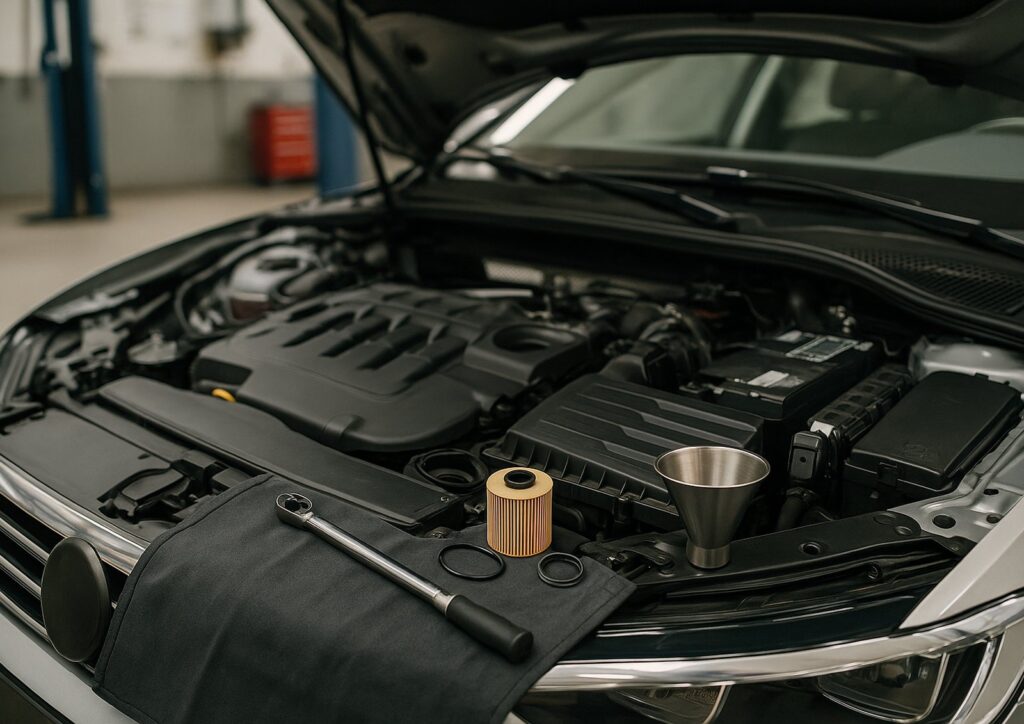
The minor service is built around the oil:
- An engine oil and filter change, using oil that carries the Audi approval your engine calls for
- A check and top-off of fluid levels
- A tire inspection and pressure correction
- A brake inspection
- A reset of the service indicator
Using the right oil matters more on an Audi than on many cars. Turbocharged, direct-injection engines are sensitive to oil quality, and the approval number on the bottle is how you know the oil meets Audi’s specification.
What is in a standard service
The standard service includes everything in the minor service, then adds a longer list of inspections and replacements. Depending on the model and year, that typically means a cabin filter replacement along with checks of the suspension, steering, exhaust, underbody, lights and the rest of the systems a minor visit only glances at. The exact list varies by model, which is why the shop should work from your car’s own service data rather than a generic chart.
Items with their own clocks
Some parts of the Audi service schedule do not follow the minor and standard rhythm:
| Item | Typical interval | Notes |
|---|---|---|
| Brake fluid | Every 2 years | Regardless of mileage |
| S tronic transmission fluid | Varies by model | Some models list 40,000 miles, others longer |
| Spark plugs | Varies by engine | Often 40,000 to 80,000 miles, with a time limit too |
| Engine air filter | Varies by model | Checked at services, replaced on schedule |
Because these vary so much between engines and transmissions, they are easy to miss when a car changes hands or moves between shops. The S tronic fluid service in particular is worth confirming on any Audi with a dual-clutch gearbox. Our guide to Audi DSG and S tronic mechatronic problems explains why that fluid matters.
What Florida driving adds
The schedule is written for average conditions. Jacksonville is not average for a car.
- Battery. Heat, not cold, is what kills batteries here, and modern Audis are hard on them. A battery test at every service catches a weak one before it strands you.
- Cooling system. Plastic coolant parts and water pumps work hard through a Florida summer. A look for seepage at each visit is cheap insurance against an overheated engine.
- Tires. Tires age in the heat even with plenty of tread left. Check the date code on the sidewall.
- Air conditioning. It runs most of the year here, so cabin filter changes and a check of system performance matter more than the schedule suggests.
- Short trips. Short, hot trips are harder on oil than highway miles, which is one more reason not to stretch the interval.
If a warning light shows up between services, our guide to the Audi check engine light covers the common causes.
Higher-mileage Audis
As an Audi passes the warranty years, the schedule stays the same but the inspection findings change. Timing chain components on some engines, carbon buildup on direct-injection intake valves and oil leaks are the items we watch most closely. Our guides to Audi timing chain warning signs and carbon buildup on direct-injection engines go deeper.
Dealer or independent?
You can have your Audi maintained wherever you choose. The Federal Trade Commission explains that routine maintenance at an independent shop does not void a manufacturer warranty. What protects the warranty is doing the work to Audi’s specifications, with the correct parts and fluids, and keeping the records. A specialist with factory-level diagnostic tools can read the car’s own service requirements and reset the indicator the same way a dealer does.
Own another German car too? See our BMW maintenance schedule and Mercedes Service A guides.
Frequently asked questions
How often does an Audi need to be serviced?
What is the difference between an Audi minor and standard service?
Does my Audi need a service every 10,000 miles?
How often should Audi brake fluid be changed?
Will servicing my Audi at an independent shop void the warranty?
Keep your Audi on schedule
Bring the car in when the service reminder comes up and we will read exactly what it is asking for, do the work to Audi specification, reset the indicator and walk you through anything else we see, including the Florida items the reminder never mentions.
Southside Euro is an independent European specialist on Sunbeam Road in Jacksonville, working on Audi every day alongside BMW, Mercedes-Benz, Volkswagen, Porsche and Volvo. See what we cover on our Audi maintenance page.