













If you own a Mercedes equipped with mercedes airmatic suspension and the car is starting to squat in the garage overnight, you already know the next chapter of this story is going to be expensive. Airmatic failures are one of the most dreaded repairs on a modern Mercedes-Benz, partially because the parts themselves are pricey, partially because one failure cascades into another, and partially because the diagnostic process eats labor hours. The good news? Not every owner needs to write a $4,000 check. Between selective component repair, full system restoration, and the increasingly popular coil-spring conversion route, there are real options on the table.
This guide covers how Airmatic works, which chassis are affected, the diagnostic process, where the repair dollars go, and the math behind choosing between a factory-correct rebuild and an aftermarket coil conversion kit.

What Airmatic Actually Is — And Why It’s Not ABC
Airmatic is Mercedes-Benz’s air-spring suspension system with electronically controlled adaptive damping. Each corner of the car uses an air strut — a rubber bladder wrapped around a shock absorber — instead of a steel coil spring. A trunk-mounted compressor pumps air into a central reservoir, and a valve block routes that air to each strut individually based on inputs from ride height sensors and the suspension control module. The result, when everything is healthy, is the floating ride and self-leveling capability Mercedes drivers expect.
Airmatic gets confused with ABC (Active Body Control) constantly, and the two systems are not the same. ABC is a hydraulic system that uses high-pressure fluid, a tandem pump driven off the engine, hydraulic struts, and pulsation dampers — you will find ABC on certain CL and SL chassis, and it has an entirely different failure profile and repair cost structure. Airmatic is purely pneumatic. If your warning light says “AIRMATIC” or “VISIT WORKSHOP,” and your car uses an air compressor in the trunk or under the spare tire well, you are dealing with Airmatic, not ABC.
The Self-Leveling Trick
One of the reasons Mercedes engineered Airmatic in the first place is load compensation. Throw four passengers and luggage in a W221 S550 and the car automatically pumps the rear up to maintain ride height. Switch into Sport mode and the system drops the body by 15mm to lower the center of gravity. Highway speed triggers an automatic drop on most chassis. When the system fails, you lose every one of those behaviors.
Which Mercedes Models Are Affected
Airmatic shows up across a wide range of Mercedes chassis from the late 1990s onward. The most commonly affected platforms include:
- S-Class W220 (2000-2006) — the first mass-market Airmatic platform; struts are aging out across the entire production run
- S-Class W221 (2007-2013) — the most-repaired Airmatic chassis on the road today
- S-Class W222 (2014-2020) — newer struts hold up better but compressors and valve blocks still fail
- E-Class W211 (2003-2009) — only specific trims, primarily wagons (S211) which used Airmatic on the rear axle for load leveling, and 4MATIC variants
- E-Class W212 (2010-2016) — wagons and select sedans
- CLS-Class (W219, W218) — Airmatic optional, common on AMG variants
- ML-Class W164 (2006-2011) and W166 (2012-2015) — Airmatic was an option, very common on ML550 and ML63
- GL-Class X164/X166 and GLS X167 — large SUVs almost always specified with air suspension
- GLE (W166, W167) — successor to ML; Airmatic standard on higher trims
- R-Class W251 (2006-2013) — Airmatic was standard equipment; failures are universal at this point
If your car is a W251 R-Class or a W164 ML, statistically the airmatic suspension failure has either already happened or is about to. These chassis are now 12 to 20 years old and the rubber bladders inside the air struts have a finite service life.
How the System Works and What Fails First
Understanding Airmatic component-by-component makes the repair conversation much easier. Five major pieces do the work, and Mercedes air suspension problems follow a predictable cascade among them.
Air Struts (Most Common Failure)
Each corner has its own air strut. The lower portion is a damper with adaptive valving controlled by a solenoid (Continuous Damping Control or ADS depending on the chassis). The upper portion is a rubber bellows that holds compressed air. The bellows is the wear item — UV exposure, ozone, and simple flex cycles eventually cause it to crack along the folds. Front struts usually go first because they take more load and more steering input. The leak starts small, with the car only sagging after sitting overnight, and gets worse until the car is visibly low within an hour of shutdown.
Air Compressor (The Cascade Victim)
Mounted in the trunk floor on sedans, under the spare tire on SUVs, or behind the front wheel arch on some chassis. Mercedes typically uses a Wabco or AMK piston compressor with an integrated dryer cartridge. The dryer is critical — water in the air lines kills valve solenoids — and on most chassis the dryer cannot be serviced separately. This is where the cascade becomes expensive: a leaking strut means the compressor works nonstop to maintain ride height. The motor was designed for short bursts every few minutes, not continuous operation. Continuous run heats the motor, scorches the windings, bakes the dryer, and eventually trips a thermal fuse or burns out entirely. The strut killed the compressor.
Valve Block, Sensors, and Control Module
The valve block is the brain of the air distribution. A bank of solenoid valves directs air into a specific strut, out to atmosphere, or into the central reservoir. Moisture from a failed dryer corrodes valve seats and solenoids stick partially open or closed — symptoms include one corner that won’t level, slow leak-down on a single corner with no visible strut damage, or the system venting air audibly when you shut the car off. Ride height sensors (one per corner, mechanical lever-arm units) report suspension travel to the control module. Connector corrosion or broken linkage from a botched alignment cause the module to either command wrong corner height or set a fault and disable the system. The reservoir stores compressed air so the system can level without running the compressor every time.
Symptoms in the Order You’ll Notice Them
The progression is almost universal. Pay attention to where you are in the sequence — it tells you how much time you have before the bill grows. Stage One is overnight sag: you walk out in the morning and one corner, usually a front, is visibly lower than the others; drive a half mile and the car levels itself. At this stage you have a small bellows leak and a compressor starting to work harder than it should. Stage Two is the AIRMATIC warning light — a “VISIT WORKSHOP” message or a yellow “AIRMATIC” warning on the cluster, meaning the control module has detected ride height out of spec for too long, or the compressor running beyond its allowed duty cycle. Stage Three is the compressor running constantly, sometimes for several minutes after shutdown, fighting a losing battle against a leaking strut, with compressor death imminent. Stage Four is no adjustment at all, with the car sitting on the bumpstops — at this point you are likely replacing struts, compressor, and possibly the dryer or valve block in the same visit.
Diagnostic Process — The Right Way
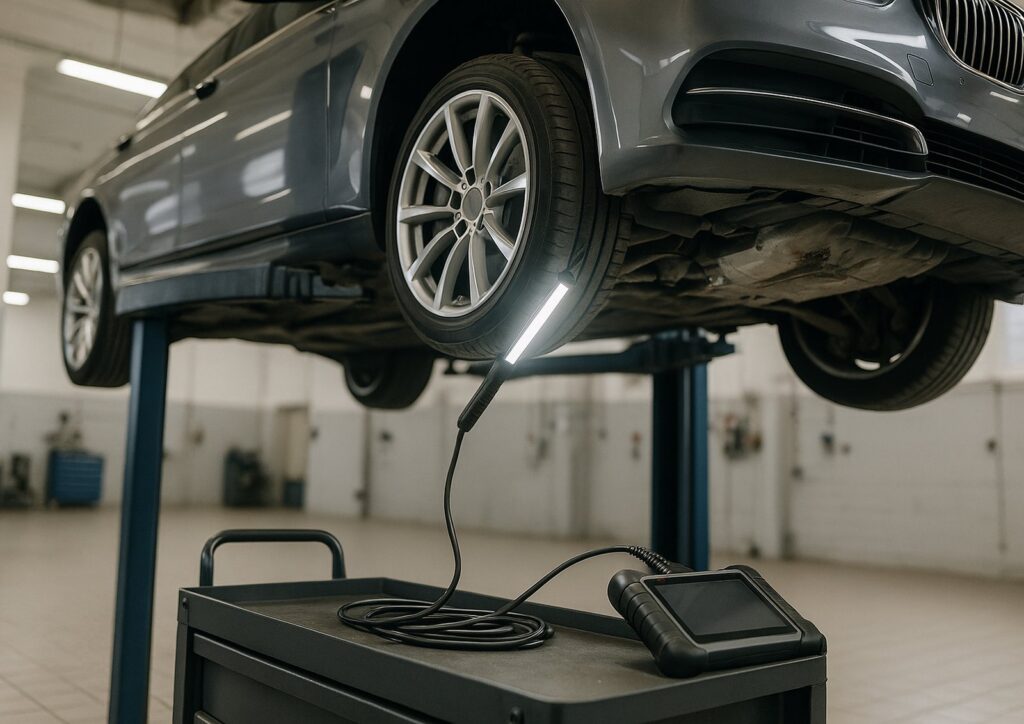
This is where shops separate. A general mechanic throws a strut at it. A Mercedes specialist starts with data. Proper Airmatic diagnostics begin with XENTRY or STAR — the Mercedes factory diagnostic platform. The Airmatic control module logs every fault, every commanded ride height, every leak-down event, and every compressor duty cycle. A scan tells you whether the module is reporting strut leak-down (and which corner), compressor over-temperature events, valve block command failures, or sensor signal errors. Generic OBD-II scanners cannot read this data — you need full Mercedes coverage.
Pinch Test on the Air Lines
With the car raised and the system pressurized, a technician can isolate sections of the air system using line pinch-off pliers. Pinch the supply line to a specific strut and watch ride height: if the corner stops dropping, the leak is downstream of the pinch (the strut). If the corner keeps dropping, the leak is upstream (a line, fitting, or the valve block). This is old-school but extremely reliable.
Valve Block Bench Test and Compressor Current Draw
If a valve block is suspected, removing it and testing each solenoid individually with shop air at controlled pressure confirms which valves are sticking. This avoids the expensive mistake of replacing a $1,200 valve block when the actual problem is a $400 height sensor. A clamp meter on the compressor power lead reveals motor health — a healthy compressor draws within spec on startup and tapers as the system pressurizes; a failing one draws excessive current the entire run cycle.
Repair Costs — What You’ll Actually Spend
Costs vary by chassis, market, and parts strategy (OE Mercedes, OE-supplier like Wabco/Bilstein, or aftermarket like Arnott). The ranges below are realistic for the Jacksonville market on most affected chassis.
Mercedes Air Strut Replacement
This is the single biggest line item. Front air struts run roughly $700 to $1,500 each in parts, depending on chassis and brand. A W221 S550 front strut at OE pricing can hit the upper end; an Arnott replacement on the same car comes in lower. Rear struts are simpler (fewer adaptive damping electronics) and run $500 to $1,000 each. Labor is typically 2 to 4 hours per pair depending on chassis.
Compressor and Valve Block Replacement
Compressor units run $300 to $800 in parts. Wabco and AMK OE-quality units sit at the higher end, aftermarket assemblies cheaper. Labor is generally 2 to 3 hours including system bleed and re-pressurization. Always replace the dryer at the same time — installing a new compressor on a saturated dryer cartridge is asking for the new compressor to die early. Valve blocks run $500 to $1,500 for the part depending on chassis with 1.5 to 2.5 hours labor, and the system needs careful purging and a Mercedes scan tool to recalibrate ride heights afterward.
The Full Restoration Bill
On a high-mileage W221 S-Class where everything has aged together — four struts, compressor, dryer, valve block, and a height sensor or two — total cost can reach $4,000 to $6,000 in parts and labor. This is the number that scares owners away from Mercedes ownership and pushes them toward conversion kits.
The Coil Conversion Option
The aftermarket has responded to Airmatic costs with a variety of airmatic to coil conversion kits. Companies like Arnott, Bilstein, Strutmasters, and a handful of smaller manufacturers offer kits that replace the air struts with conventional coil-over assemblies and, in some kits, include a bypass module that prevents the dashboard from throwing fault codes. A typical kit includes coil springs (rated for the specific chassis weight), conventional shock absorbers, mounting hardware, and depending on the brand, a CAN-bus bypass module that emulates the signals the ride height sensors would normally send. Kit pricing runs roughly $600 to $2,500 depending on chassis. An ML W164 conversion kit sits at the lower end; a W221 S-Class four-corner conversion at the upper end.
Pros and Cons of Conversion
The pros: significantly cheaper than a full Airmatic restoration, no compressor or valve block or air lines to fail, coil springs and conventional dampers last 60,000 to 100,000 miles without intervention, and one bad component doesn’t kill three others. The cons are real too. You lose the floating, adaptive feel that Mercedes engineered the car around — the chassis was tuned with air springs in the geometry, and coil springs change the feel noticeably. You lose self-leveling, so loading up the trunk or third row makes the car squat. You lose height adjustment: Sport mode can’t lower the car, highway drop is gone. Without a bypass module the airmatic warning light stays on permanently, and even with a bypass, some chassis still log certain codes that need manufacturer-specific coding to suppress. And resale takes a hit — buyers familiar with these chassis will discount a converted car, sometimes substantially.
This is why the conversion question is genuinely a math problem and not a no-brainer. At Southside Euro, the conversation we have with owners is usually about how long they plan to keep the car. If it’s a five-more-years-and-pass-it-to-the-kid scenario, conversion makes sense. If it’s a keep-it-pristine S-Class for the next decade, restoration is the right call.
When Repair Makes Sense vs When Conversion Does
Use this framework. It’s not perfect but it captures the decision well. Repair (or restore properly) when the car is a W222, W212, W167, or any chassis from roughly 2014 onward where parts are still well-supported and the car has years of service life ahead; when you drive enthusiastically and value the adaptive ride character that came with the car; when you’re planning to sell within the next year or two (converted cars sell for less); when only one or two components have failed (catch it at Stage One); or when you haul passengers or cargo regularly and need self-leveling.
Convert when the car is a high-mileage W220, W164, or W251 where the entire system is aging out simultaneously; when you’ve already replaced one or two components and the rest are showing symptoms; when you plan to keep the car for utility rather than ride feel (daily driver, work truck, kid hauler); when the cost differential between restoration and conversion exceeds $2,000 on your specific car; or when you’re comfortable with the warning light situation and the shop can properly code out the codes.
Florida and Heat — Does Climate Matter?
Jacksonville heat is hard on a lot of European car components, but Airmatic struts are not at the top of the climate-victim list. Heat accelerates rubber degradation and ozone exposure shortens bellows life, but the dominant failure drivers on Airmatic are time and cycles, not temperature. A W221 S-Class in Minnesota and one in Florida will both reach end-of-life on their original air struts somewhere in the 8-to-12-year range, give or take road salt and humidity considerations.
What does affect Florida cars more is humidity finding its way into the air system. Moisture in the lines accelerates valve block solenoid corrosion. The compressor’s dryer cartridge is what protects against this, which is why Southside Euro always replaces the dryer when replacing the compressor on a Florida car — the saturation state of the dryer is part of the cost calculation, not an optional add-on.
Frequently Asked Questions
How much does it cost to fix Airmatic on a Mercedes?
Should I convert to coil springs instead of repairing Airmatic?
Can I drive with a sagging Airmatic?
Why does my Mercedes sit low overnight?
Will coil conversion trigger warning lights on the dashboard?
Airmatic isn’t a system to fear — it’s a system to understand. Caught early, individual repairs are manageable. Allowed to cascade, the bills get serious. When the math no longer favors restoration, the conversion route is a legitimate path that thousands of owners have taken. The right diagnosis comes first either way, and that requires the Mercedes-specific tooling and chassis experience to read what the system is actually telling you.