













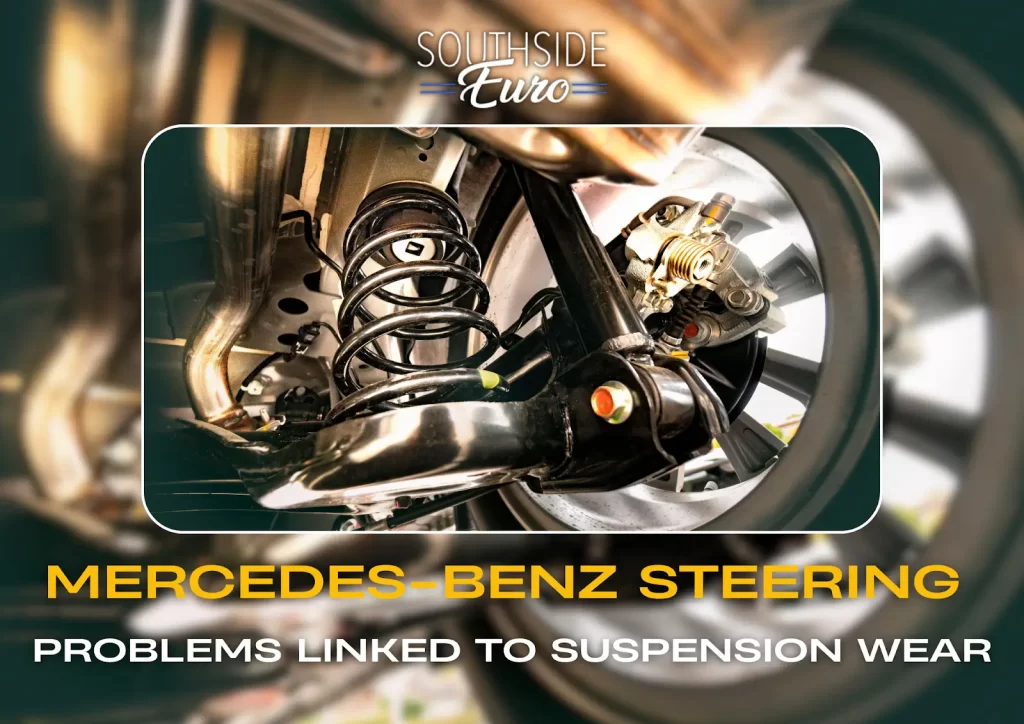
Mercedes-Benz vehicles deliver exceptional handling and ride quality through sophisticated suspension systems that integrate multiple components working in precise harmony. When suspension wear begins affecting steering performance, many owners assume they’re experiencing separate, unrelated problems.
The reality is that Mercedes-Benz engineers design suspension and steering systems as interconnected mechanisms where component wear in one area directly impacts the other. Understanding this relationship helps owners recognize early warning signs before minor wear escalates into comprehensive failures requiring thousands in repairs.

The Mercedes-Benz Suspension and Steering Integration
Engineering Philosophy Behind the Connection
Mercedes-Benz suspension systems use multi-link designs with numerous pivot points, bushings, and control arms that maintain precise wheel geometry. The steering system relies on this geometry remaining within tight tolerances to deliver the brand’s signature road feel and handling characteristics.
Unlike simpler suspension designs with fewer components, Mercedes vehicles employ:
- Multi-link rear suspension with five or more control arms per wheel
- Complex front suspension with multiple ball joints and bushings
- Steering rack mounted to subframe with rubber isolation bushings
- Electronic stability systems that monitor wheel position constantly
When suspension components wear, they allow movement beyond design specifications. This excess movement translates directly to the steering wheel as:
- Vague steering feel
- Wandering on highway
- Delayed response to inputs
- Vibrations through the steering column
Common Mercedes Models Affected
Mercedes-Benz E-Class (W211, W212, W213): Notorious for front lower control arm bushing failures that cause steering wander and vibration. The multi-link front suspension uses aluminum control arms with pressed-in rubber bushings that deteriorate between 60,000-80,000 miles.
Mercedes-Benz C-Class (W204, W205): Develops steering issues from worn front strut mounts and thrust arm bushings. The compact chassis amplifies suspension wear effects, making steering problems noticeable earlier than larger models.
Mercedes-Benz S-Class (W220, W221, W222): Air suspension models experience steering problems when air springs leak and the vehicle sits unevenly. The adaptive suspension system cannot compensate for failed components, creating dangerous handling characteristics.
Mercedes-Benz ML/GLE-Class: SUV models face accelerated suspension wear from higher weight and center of gravity. Steering rack bushings and lower control arm bushings fail prematurely, causing pronounced steering issues.
Suspension Components That Affect Steering Performance
Control Arm Bushings: The Primary Culprit
Control arm bushings connect suspension arms to the chassis and allow controlled movement during suspension travel. Mercedes uses rubber bushings filled with hydraulic fluid (hydro-mount bushings) that provide excellent vibration isolation when new.
Over time, these bushings deteriorate from:
- Heat cycling from brake and exhaust proximity
- Road salt attacking rubber compounds (especially relevant in northern climates)
- Age-related hardening causing loss of flexibility
- Hydraulic fluid leakage reducing damping properties
Failed control arm bushings create excessive play in the suspension geometry. When you turn the steering wheel, there’s a delay as suspension components move through the excess play before the wheels actually turn. This manifests as:
- Steering wheel play – noticeable free movement before wheels respond
- Clunking sounds when turning at low speeds
- Wandering sensation requiring constant steering corrections
- Uneven tire wear on inside or outside edges
Ball Joint Wear and Steering Precision
Ball joints connect control arms to steering knuckles and allow suspension movement while maintaining wheel alignment. Mercedes ball joints operate under tremendous loads and wear gradually over time.
Symptoms of worn ball joints affecting steering:
- Popping or clicking when turning sharply
- Steering feels disconnected from road surface
- Vehicle pulls to one side unexpectedly
- Tire squealing during turns at parking lot speeds
Unlike domestic vehicles where ball joints often have grease fittings for maintenance, most Mercedes ball joints are sealed units requiring complete control arm replacement when they fail. The cost escalates quickly:
- Single front control arm with ball joint: $400-$800
- Complete front suspension rebuild: $2,500-$4,000
- Labor-intensive installation requiring alignment afterward
Strut Mounts and Steering Response
Strut mounts sit atop the front struts and serve multiple functions:
- Support vehicle weight
- Allow strut rotation during steering
- Isolate road noise and vibration
- Maintain proper strut alignment
Failed strut mounts create several steering-related symptoms:
Clunking over bumps – particularly noticeable during low-speed turns over speed bumps or parking lot ramps. The worn mount allows the strut to shift position, creating metallic clunking sounds transmitted through the steering column.
Steering returnability issues – after completing a turn, the steering wheel doesn’t self-center properly. The worn mount adds friction to the strut’s rotation, preventing the suspension’s natural tendency to return to center position.
Vibration at highway speeds – worn strut mounts allow the strut to move excessively, creating vibrations that resonate through the steering wheel. This often worsens between 60-70 mph as suspension oscillation reaches resonant frequency.
Tie Rod Ends: Direct Steering Connection
Tie rod ends connect the steering rack to the steering knuckles, directly translating steering input into wheel movement. When tie rod ends wear, the effect on steering is immediate and dangerous.
Warning signs include:
- Excessive steering wheel play – sometimes 2-3 inches of movement before wheels respond
- Vehicle doesn’t track straight – constant corrections needed to maintain lane position
- Squeaking or groaning when turning at low speeds
- Uneven tire wear – particularly feathering on inside edges
Worn tie rod ends represent a safety hazard. Severe wear can cause tie rod separation, resulting in complete loss of steering control. The suspension repair should be performed immediately when tie rod wear is detected.
Steering Rack Bushings and Mounting Points
The steering rack mounts to the front subframe through rubber bushings that isolate vibration and allow minor movement. These bushings wear from:
- Constant steering inputs creating movement
- Engine vibration transmitted through subframe
- Age-related rubber deterioration
- Fluid contamination from steering rack leaks
Failed steering rack bushings create a characteristic symptom: the steering wheel moves slightly left or right when accelerating or braking hard. The rack shifts position within its mounts, causing the steering wheel to move even though you haven’t turned it.
Additional symptoms:
- Knocking sounds from the dashboard area when hitting bumps
- Steering feels loose with excessive play at center position
- Variable steering effort – sometimes easy, sometimes difficult
- Alignment won’t hold – vehicle pulls differently after each alignment
Air Suspension Systems and Steering Complications
Airmatic Suspension Overview
Mercedes-Benz Airmatic suspension uses air springs instead of conventional coil springs. Electronic sensors monitor vehicle height, and the system adjusts air pressure to maintain proper ride height regardless of load.
When the system functions correctly, it provides:
- Superior ride quality over varied road surfaces
- Automatic leveling when carrying heavy loads
- Adjustable ride height for different driving modes
- Integration with electronic stability control
How Air Suspension Failures Affect Steering
Air spring leaks cause the vehicle to sag on one corner or completely drop to minimum height overnight. This creates dangerous steering characteristics because:
Uneven ride height changes suspension geometry. Mercedes engineers design suspension geometry assuming specific ride height. When one corner sags, the suspension arm angles change, altering:
- Camber (wheel tilt)
- Caster (steering axis angle)
- Toe (wheel pointing direction)
These geometry changes cause:
- Vehicle pulling strongly to one side
- Steering wheel off-center when driving straight
- Unpredictable handling during emergency maneuvers
- Rapid tire wear on the sagging corner
Compressor overwork creates delayed response. When air springs leak, the compressor runs constantly trying to maintain pressure. Eventually, the compressor overheats and fails, leaving the vehicle sitting on bump stops.
In this condition:
- Steering feels extremely heavy
- Turning radius increases dramatically
- Wheel clearance issues may occur
- Vehicle becomes dangerous to drive
Airmatic System Repair Costs
Air suspension repairs represent substantial expenses:
- Single air spring replacement: $800-$1,500
- Air compressor replacement: $1,200-$2,000
- Complete Airmatic system overhaul: $4,000-$8,000
- Valve block replacement: $1,500-$2,500
Many owners facing multiple air suspension failures choose to convert to conventional coil spring suspension. Conversion kits cost $2,000-$3,000 installed and eliminate future air suspension problems, though ride quality and vehicle height adjustability are sacrificed.
Electronic Steering Systems and Sensor Failures
Active Steering Technology
Modern Mercedes-Benz vehicles use electronic power steering (EPS) and some models feature active steering that varies steering ratio based on speed. These systems rely on:
- Steering angle sensors monitoring wheel position
- Torque sensors measuring driver input force
- Vehicle speed sensors adjusting assist levels
- Yaw rate sensors detecting vehicle rotation
When sensors fail or suspension wear affects sensor readings, the electronic systems malfunction.
Steering Angle Sensor Issues
The steering angle sensor tells the electronic stability control system where the front wheels are pointing. Suspension wear that changes wheel position without corresponding steering input confuses this sensor.
Symptoms include:
- ESP/BAS warning lights illuminating on dashboard
- Traction control activating inappropriately during normal driving
- Cruise control disabling itself unexpectedly
- Active lane keeping pushing vehicle toward lane edges
The steering angle sensor requires recalibration after any suspension work or wheel alignment. Failure to recalibrate causes the above symptoms even with perfectly functioning suspension.
Electronic Steering Assist Failures
Electronic power steering uses an electric motor to provide assist rather than hydraulic pressure. The system adjusts assist levels based on:
- Vehicle speed (less assist at highway speeds)
- Steering input rate (more assist for quick inputs)
- Driving mode selection (Sport, Comfort, etc.)
Suspension wear affects the steering system’s ability to determine appropriate assist levels. Worn bushings and ball joints create inconsistent steering effort that the electronic system tries to compensate for, resulting in:
- Steering effort varies unpredictably – sometimes easy, sometimes stiff
- Jerky steering feel as electronic system overcorrects
- Warning messages about steering malfunction
- Limp mode activation with heavy, manual-like steering
Progressive Damage Timeline: How Suspension Wear Worsens
Stage 1: Initial Wear (40,000-60,000 Miles)
Subtle changes begin as bushings start deteriorating:
- Minor steering wheel vibration at highway speeds
- Slight vagueness in steering response
- Occasional small clunk over sharp bumps
- Tire wear pattern beginning to show irregularity
Most owners don’t notice these early symptoms or attribute them to normal wear. However, this stage represents the ideal time for preventive maintenance before damage spreads to other components.
Stage 2: Moderate Wear (60,000-80,000 Miles)
Symptoms become more pronounced and annoying:
- Consistent steering wander requiring constant correction
- Noticeable play in steering wheel
- Clunking sounds obvious during turns and over bumps
- Uneven tire wear accelerating, requiring premature replacement
- Vehicle pulling to one side despite recent alignment
At this stage, worn bushings allow excessive movement that accelerates wear on other suspension components. Ball joints and tie rod ends experience higher stress loads than designed, reducing their service life.
Stage 3: Severe Wear (80,000+ Miles)
Dangerous conditions develop requiring immediate attention:
- Significant steering wheel play – 2-3 inches of movement before wheels respond
- Loud clunking and banging over even minor road irregularities
- Vehicle handling becomes unpredictable and dangerous
- Tire wear so severe that tires need replacement every 15,000-20,000 miles
- Other suspension components failing from stress of compensating for worn parts
Stage 4: Catastrophic Failure
Continuing to drive with severely worn suspension risks:
- Tie rod separation causing complete loss of steering
- Ball joint failure allowing wheel to collapse
- Control arm breakage from stress cracks
- Accident from inability to control vehicle
Emergency repairs at this stage cost $3,000-$6,000 and include extensive collateral damage to components that could have been preserved with earlier intervention.
Diagnostic Procedures for Suspension-Related Steering Issues
Visual Inspection Techniques
Professional technicians identify suspension wear through systematic inspection:
Bushing condition assessment: Inspecting for cracks, tears, fluid leaks, or deformation. Rubber bushings should be pliable and show no visible damage. Hardened, cracked bushings indicate replacement is needed.
Ball joint play testing: Using pry bars to check for vertical and horizontal movement in ball joints. Any detectable play indicates wear beyond specification. Mercedes specifies extremely tight tolerances – typically less than 0.020 inches.
Tie rod end checking: Grasping the tire at 3 and 9 o’clock positions and attempting to move it side-to-side. Movement indicates inner or outer tie rod end wear. Additional checks with wheels turned full lock reveal wear not visible in straight-ahead position.
Specialized Diagnostic Equipment
European car diagnostic services utilize advanced tools:
Wheel alignment machines with before/after measurements showing how suspension wear affects geometry. Excessive camber, caster, or toe changes indicate specific suspension components failing.
Suspension load testers that apply force to suspension components while measuring deflection. This identifies worn bushings that don’t show obvious visual damage but allow excessive movement.
Electronic steering system scanners that retrieve fault codes from multiple control modules. These codes pinpoint sensor failures and electronic system malfunctions caused by suspension wear.
Road test procedures where experienced technicians evaluate:
- Steering response at various speeds
- Bump absorption and isolation
- Noise and vibration characteristics
- Self-centering behavior
- Straight-line stability
Brand-Specific Suspension Weak Points
W211 E-Class (2003-2009)
The W211 generation E-Class suffers from well-documented suspension issues:
Front lower control arm bushings fail between 60,000-80,000 miles. The aluminum arms use pressed-in hydraulic bushings that cannot be replaced separately, requiring complete control arm replacement at $400-$600 per side.
Front strut mounts develop clunking and affect steering returnability. Replacement costs $300-$500 per side including labor.
Airmatic air springs on equipped models leak at the upper or lower mounting points. Replacement costs $800-$1,200 per corner.
W212 E-Class (2010-2016)
The W212 improved some issues but introduced new ones:
Thrust arm bushings wear rapidly, causing steering vibration and wandering. These large control arms mount to the front subframe and control longitudinal wheel movement. Replacement requires $600-$900 per side.
Upper control arm ball joints wear faster than expected, particularly on AMG models with larger wheels and tires. Complete upper control arm assemblies cost $500-$800 each.
W204 C-Class (2008-2014)
The smaller C-Class experiences:
Front lower control arm bushings failing even earlier than E-Class, sometimes by 50,000 miles. The lighter chassis amplifies the effect of worn bushings, making symptoms more noticeable.
Steering rack bushings deteriorate from engine vibration transmitted through the subframe. Replacement requires dropping the subframe, adding significant labor costs of $800-$1,200.
W221 S-Class (2007-2013)
The flagship S-Class faces unique challenges:
Airmatic system complexity with adaptive damping and active body control. Multiple failure modes affect steering, including compressor failures, valve block issues, and height sensor malfunctions. Complete system repairs can exceed $8,000.
Steering rack wear from the heavy vehicle weight and large wheel/tire combinations. Rack replacement costs $2,500-$4,000 installed.
Preventive Maintenance and Inspection Schedule
Regular Inspection Intervals
Mercedes-Benz suspension components should be inspected:
Every oil change (10,000 miles): Visual inspection for obvious damage, leaks, or torn boots. Quick assessment of steering response during test drive.
Every 30,000 miles: Comprehensive suspension inspection including:
- All bushings for cracks and deterioration
- Ball joints for play
- Tie rod ends for wear
- Steering rack for leaks
- Boot condition on all components
Every 50,000 miles: In-depth diagnostic inspection with vehicle on alignment rack to measure suspension geometry and identify developing issues before symptoms appear.
Component Replacement Timing
Proactive replacement prevents collateral damage:
Control arm bushings: 60,000-80,000 miles depending on driving conditions. City driving with frequent turning accelerates wear. Highway driving extends service life.
Strut mounts: 80,000-100,000 miles. Consider replacement when having struts replaced rather than waiting for failure.
Ball joints: 100,000-120,000 miles. Some Mercedes control arms integrate ball joints requiring complete arm replacement.
Tie rod ends: 80,000-100,000 miles. Inner and outer tie rods often wear at different rates. Replace both sides simultaneously for consistent steering feel.
Alignment After Suspension Work
Critical importance: Every suspension component replacement requires wheel alignment afterward. Failure to align the vehicle causes:
- Rapid tire wear consuming new tires in 10,000-15,000 miles
- Steering pull to one side
- Off-center steering wheel
- Vehicle handling characteristics worse than before repair
Professional wheel alignment service costs $150-$250 but protects your $800-$1,200 tire investment.
Steering Symptoms Requiring Immediate Attention
Dangerous Warning Signs
Some symptoms indicate urgent safety concerns:
Steering wheel rapidly vibrating at highway speeds suggests severe suspension wear or wheel imbalance combined with worn components. The oscillation can worsen suddenly, making vehicle uncontrollable.
Clunking when braking often indicates worn lower control arm bushings allowing excessive forward/backward movement. This affects emergency braking effectiveness.
Vehicle pulling strongly to one side with steering wheel off-center indicates significant suspension geometry problems. Continuing to drive risks tire failure or accident.
Steering feels completely disconnected from the road surface suggests severe ball joint or tie rod wear approaching failure point.
When to Stop Driving
Immediately cease operation if experiencing:
- Grinding or scraping sounds from wheel area during turning
- Sudden increase in steering effort required
- Steering wheel shaking violently at any speed
- Visible fluid leaking from steering rack or lines
- Warning lights for steering, ESP, or BAS systems
These symptoms indicate imminent component failure that could cause loss of vehicle control. Arrange for towing to prevent accident or additional damage.
Cost Comparison: Early Intervention vs. Delayed Repair
Proactive Maintenance Scenario
Addressing suspension wear at first symptoms:
Initial repair at 60,000 miles:
- Front lower control arms (both): $800-$1,200
- Wheel alignment: $150-$250
- Total: $950-$1,450
Result: Steering returns to like-new condition. Tie rod ends, ball joints, and other components last full service life. Tires wear evenly for 40,000-50,000 miles.
Delayed Repair Scenario
Ignoring symptoms until 90,000 miles:
Comprehensive repair required:
- Front lower control arms (both): $800-$1,200
- Front upper control arms (both): $1,000-$1,600
- Tie rod ends (inner and outer, both sides): $600-$900
- Strut mounts (both): $400-$600
- Wheel alignment: $150-$250
- Total: $2,950-$4,550
Additional costs:
- Premature tire replacement: $800-$1,200
- Damaged wheel bearings from misalignment: $600-$1,000
- Grand total: $4,350-$6,750
The delayed repair costs 3-5 times more than addressing problems early.
Professional Mercedes-Benz Suspension Service at Southside Euro
Specialized Mercedes Expertise
Our Mercedes-Benz specialists understand the intricate relationship between suspension and steering systems. We’ve serviced hundreds of Mercedes vehicles experiencing suspension-related steering problems since 2019.
Our technicians receive ongoing training on:
- Mercedes-specific suspension designs
- Electronic steering system diagnostics
- Airmatic suspension troubleshooting
- Proper installation procedures for precise geometry
OEM-Quality Parts and Proper Installation
We exclusively use OEM or OEM-equivalent parts meeting Mercedes engineering specifications. Aftermarket parts from unknown manufacturers often fail prematurely or change vehicle handling characteristics.
Our installation process includes:
- Torque specifications followed precisely using calibrated tools
- Bushing orientation verified for proper function
- Steering angle sensor recalibration after any suspension work
- Four-wheel alignment with before/after documentation
- Road test verification ensuring all symptoms resolved
Comprehensive Diagnostic Approach
We don’t guess at suspension problems. Our diagnostic process includes:
- Complete visual inspection of all suspension components
- Test drive evaluation with experienced technician
- Alignment measurements showing current vs. specification
- Electronic system scanning for sensor and computer faults
- Detailed estimate explaining all needed repairs with prioritization
Jacksonville’s Mercedes Specialists
Located at 4583 Sunbeam Rd., Jacksonville, FL 32257, Southside Euro provides expert suspension repair services for all Mercedes-Benz models.
Don’t let suspension wear compromise your Mercedes steering and handling. Call (904) 240-1440 to schedule a comprehensive suspension inspection today.