













Summarize this article with:
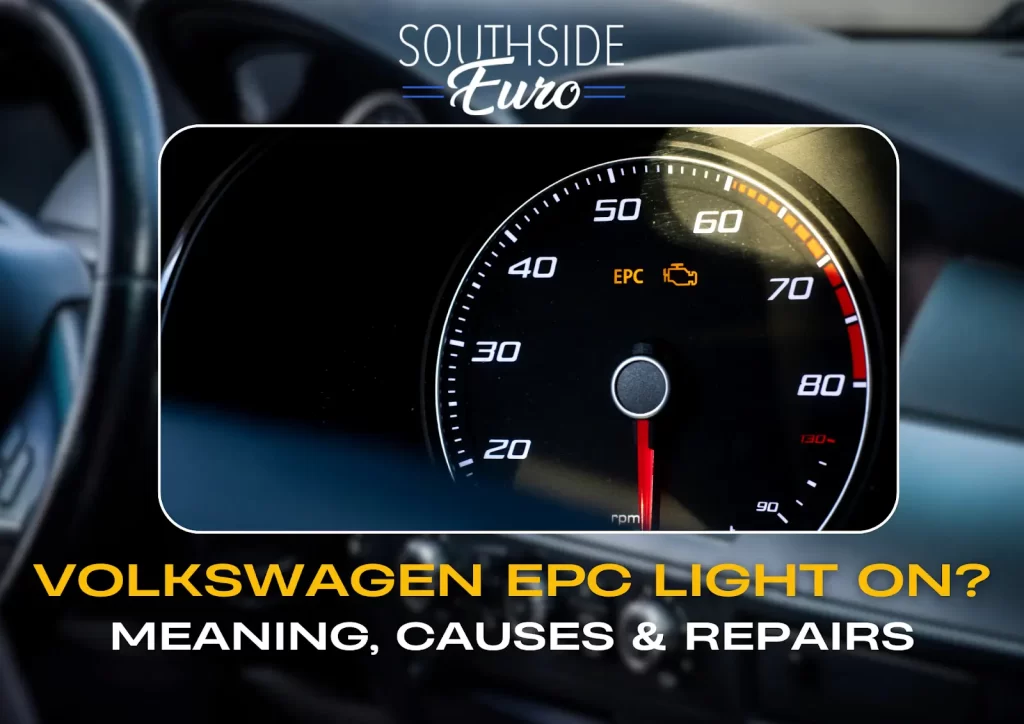
The EPC light is on. The useful question is not what the letters stand for. It is whether you can finish your drive, and whether this is a driveway job or a shop job. That depends on what else your car is doing.
The short version. EPC stands for Electronic Power Control. It is not a part. It is the warning lamp for the whole chain that decides how much power your engine makes: the accelerator pedal sensor, the electronic throttle, and the stability systems allowed to pull power back. It means one of those modules stored a fault. If the car drives normally, get it scanned soon. If it went into limp mode, or the check engine light is flashing, get off the road. A restart may drop the lamp, but the fault is still stored, and clearing a code without fixing what set it is why it comes back.

Jacksonville's
Most Trusted
Euro Car Shop
Book Your Appointment Today
Key Takeaways
- What EPC stands for, and why it is not a single part
- Read the other lights, they narrow it down more than you think
- Limp mode, and the first sixty seconds
- What actually sets it off on VW and Audi
- The adaptation trap, and why the light keeps coming back
What EPC stands for, and why it is not a single part
EPC is Electronic Power Control. Volkswagen and Audi use the same lamp for the same reason, because under the badge they share the same architecture. A Jetta, a Golf, a Tiguan, a Passat, an A3, an A4 and a Q5 are all telling you the same thing.
Here is the part most articles skip. On these cars there is no cable from your foot to the throttle, and there has not been one for well over twenty years. Your accelerator pedal is a sensor. The throttle is a small electric motor. In between sits a control module that reads what your foot asked for, checks it against a stack of other inputs, and decides how far to open that throttle. The EPC lamp watches that whole chain, plus traction and stability control, because those can order the engine to reduce power.
That is why the cause list looks random. A brake light switch and a wheel speed sensor have nothing in common mechanically, but both feed a module that can cut engine power. You are not hunting for one broken part. You are working out which module raised its hand.
Read the other lights, they narrow it down more than you think
Before you touch anything: what else is lit, and what is the car doing?
EPC alone, engine running normally. Usually something the powertrain checks but does not need in order to run. A failed brake light switch is the classic on VW and Audi, and dead cruise control at the same time is a useful tell.
EPC plus the check engine light. A fault on the engine side too: misfires, throttle position disagreements, boost control or fuel trim problems. Our breakdown of common Audi check engine light causes covers what sits behind that second lamp.
EPC plus a flashing check engine light. Flashing means an active misfire dumping raw fuel into the exhaust, and that ruins a catalytic converter quickly. Stop driving. This one gets worse by the mile.
EPC plus traction control or ABS. The stability system lost an input, usually a wheel speed sensor or the steering angle sensor. Because stability control can pull engine power, EPC joins in.
EPC plus the battery light, or EPC after a slow crank. Think voltage before you think sensors. A battery on its way out can throw faults across several modules at once.
EPC that comes on, then goes away. The fault is still stored as an intermittent even with the lamp off. That record is why you should not disconnect the battery to make the light disappear.
Limp mode, and the first sixty seconds
Limp mode is not a failure, it is a deliberate decision. When a module cannot trust one of its inputs, it clamps throttle opening, caps engine speed, and often holds the transmission in one gear, so you can get off the road without loading up a system it can no longer measure.
You will know it. The pedal goes dead past the first third of its travel. The engine will not rev past a ceiling. The transmission may refuse to downshift when you ask for a pass.
Stop asking for power, because flooring it only stresses whatever is already faulty. Signal and get out of the travel lane. The worst place to find the limit of limp mode is halfway up an I-95 on ramp. Once you are somewhere safe, shut it off and restart. If the lamp clears and the car drives normally, you have an intermittent fault, not a fixed car. If it stays in limp mode, do not nurse it home.
What actually sets it off on VW and Audi
Notice how many of these are not engine problems at all.
The throttle body and its adaptation. Carbon buildup, a worn throttle position sensor, or a throttle body cleaned or replaced without the adaptation being run afterward. More on that below.
The accelerator pedal position sensor. These pedals carry two sensor circuits that are supposed to agree. When they stop agreeing, the module trusts neither, defaults to a safe throttle opening, and lights the lamp. You get delayed or dead throttle response.
The brake light switch. A small switch at the top of the brake pedal, and a frequent trigger on both brands. A failed switch gives you an EPC light, dead cruise control, and brake lights that stay on, stay off, or flicker.
ABS wheel speed sensors and the steering angle sensor. Both feed stability control, so both can trigger EPC alongside the ABS and traction lamps. Steering angle sensors often need recalibration after steering or suspension work.
Coil packs, plugs and misfires. A misfire the module cannot compensate for gets flagged, power gets pulled back, and EPC joins the check engine light. On turbo models a sticking wastegate actuator does the same, producing boost readings that do not match what was commanded.
Low or failing battery voltage. The one most owners never suspect. Weak voltage during cranking can set faults in several unrelated modules at once.
The adaptation trap, and why the light keeps coming back
Advice to clean the throttle body is everywhere. That is half a job, and the missing half is why people do it twice.
On a VW or Audi electronic throttle, the control module has learned where that throttle plate rests when closed and how much current it takes to move it. Clean it, disturb it, or replace it, and those learned values no longer match reality. What you get is a rough or hunting idle, a stall coming to a stop, and the EPC light straight back on within a drive cycle or two.
The fix is a throttle body adaptation, sometimes called a basic setting: a routine run with software that commands the module to relearn its own stops. A code reader will not do it. Southside Euro lists this work on its coding and programming page, which describes coding services for Audi and Volkswagen that include “recalibrating sensors.”
The wider point covers every cause above. Clearing a code turns the lamp off. It does not change the condition that set it. Codes are a symptom record, not a repair.
What you can safely check yourself
Short list, on purpose. All observation, nothing taken apart, none of it can make things worse.
Check whether your brake lights work. Have someone stand behind the car while you press the pedal, or back up to a garage door at night and watch the reflection. No brake lights, or brake lights stuck on with your foot off the pedal, points hard at the brake light switch.
Look at the battery terminals and the battery date. Are the clamps tight, clean and free of white or green crust? How old is it? Look, do not disassemble. If the car has also been cranking slowly, say so, because that changes where a technician looks first.
Note whether it went into limp mode. Did it drive normally, or refuse to rev? That detail separates a stored sensor fault from an active power limitation, and most people forget it by the time they reach the counter.
Note when the light appears. Cold start only? Under braking? Merging under load? An intermittent that shows up at a repeatable moment is far easier to catch than one described as random.
Write those four answers down. They do more for the diagnosis than any parts guess.
Then stop there. Do not disconnect the battery to clear the light, and do not clean the throttle body without the ability to run the adaptation afterward.
Where the line is, and the honest reason for it
The reason the do it yourself route stalls on this particular light has nothing to do with skill.
A basic code reader is built to talk to the engine control module and report generic emissions codes. The trouble with EPC is that many of the faults behind it are not stored there at all. Wheel speed sensor faults live in the ABS module. Steering angle faults live in their own. Brake switch and other inputs arrive across the network. A tool that reads one module comes back clean, or points at a symptom rather than a source.
That gap is what the electrical diagnostics page at Southside Euro describes: work done “with tools like BMW ISTA+, Mercedes-Benz XENTRY, Volkswagen ODIS, and Volvo VIDA,” software used to “monitor live data streams, conduct actuator tests, and analyze CAN bus signals,” and to find “software-related malfunctions that generic scanners might miss.” ODIS is the Volkswagen and Audi one. The same shop covers battery health and sensor function alongside electrical repairs, which matters given how often an EPC fault turns out to be a voltage story.
EPC faults live across several modules, and guessing which one is how people end up doing the same repair twice. A throttle body replaced when the real fault was a pedal sensor is a wasted afternoon and a light that is still on.
Get the EPC light read properly, in Jacksonville
An EPC light is not automatically bad news. Plenty come down to a brake light switch, a tired battery, or a throttle body that needs its adaptation run. What makes them frustrating is that the lamp gives no way to tell those apart from the ones that matter.
Southside Euro works on Volkswagen and Audi with the manufacturer level software these cars require, scanning every module rather than just the engine. Bring your notes: what else was lit, whether it went into limp mode, and when the light shows up.
Why did my EPC light come on and then go off?
Is the EPC light dangerous?
VW and Audi EPC Light FAQs
What causes the EPC light to come on in a Volkswagen or Audi?
Anything in the chain that controls engine power: the accelerator pedal sensor, the electronic throttle body, the brake light switch, ABS wheel speed sensors, the steering angle sensor, misfires, boost control faults, and low battery voltage. The lamp does not tell you which one, only that a module in that chain stored a fault.
Is it OK to drive with the EPC light on?
If the car drives normally and nothing else is lit, you can generally finish your trip, but get it scanned promptly. If it went into limp mode, or the check engine light is flashing, stop driving. Flashing means an active misfire, and that damages the catalytic converter fast.
Can I fix the EPC light myself?
You can check the safe things: brake lights, battery terminals, whether the car went into limp mode, and when the light returns. Identifying the actual fault is different, because many EPC related codes sit outside the engine module where a basic code reader cannot see them.
How do you turn off the EPC light on a VW?
By fixing what set it, then clearing the fault with a scan tool once the repair is verified. A restart will sometimes drop the lamp while the fault stays stored. Disconnecting the battery is not a fix, because it erases the stored fault and the freeze frame data a technician needs.
Does the EPC light mean a dead battery?
Not directly, but a weak battery is a common trigger. These cars run a lot of modules that expect stable voltage, and low voltage during cranking can set faults in several at once. If the light shows up alongside slow cranking, have the battery and charging system tested first.