













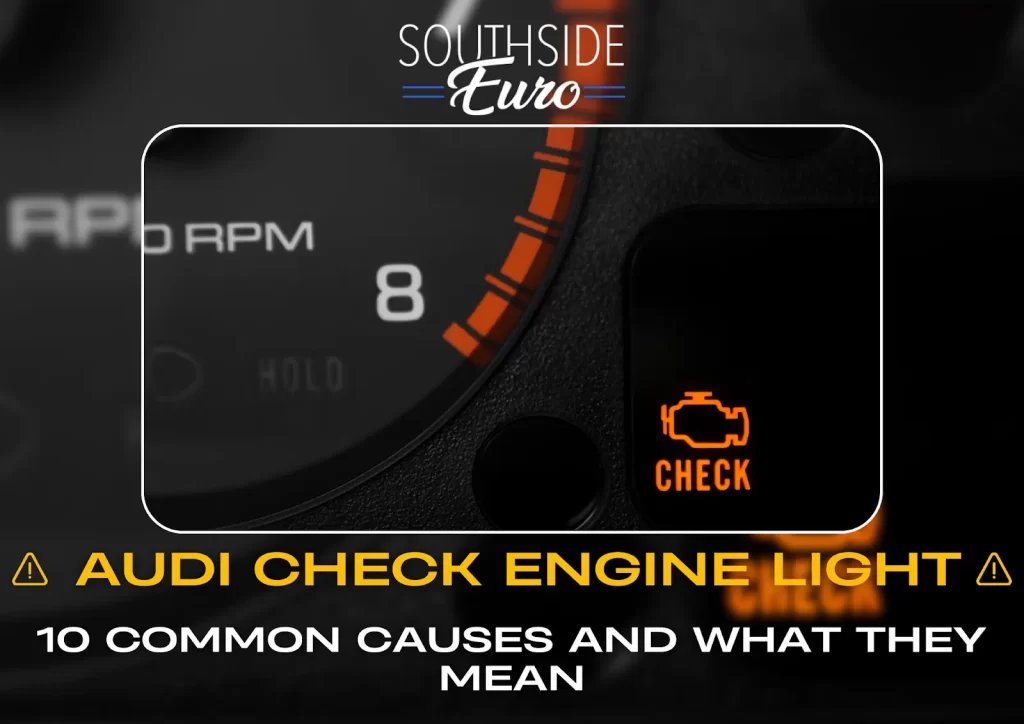
If your Audi’s check engine light comes on, it means the engine control unit has detected a fault that affects performance, emissions, or mechanical safety. Essentially, it’s not a generic warning. Audi uses strict fault thresholds, which means the light usually appears after the system has verified a real problem, not a guess.
Many Audi owners notice that the car still drives “fine” at first. That often leads to delays, code clearing, or quick DIY fixes. The problem is that Audi fault codes are layered. What starts as a minor sensor deviation can turn into misfires, fuel delivery issues, or timing-related damage if it is ignored.

In this guide, we break down the most common Audi check engine light causes based on platform-wide patterns, real ownership trends, and what European specialists consistently diagnose. You will learn what the light actually means, how to respond correctly, and which problems need immediate attention before they escalate.
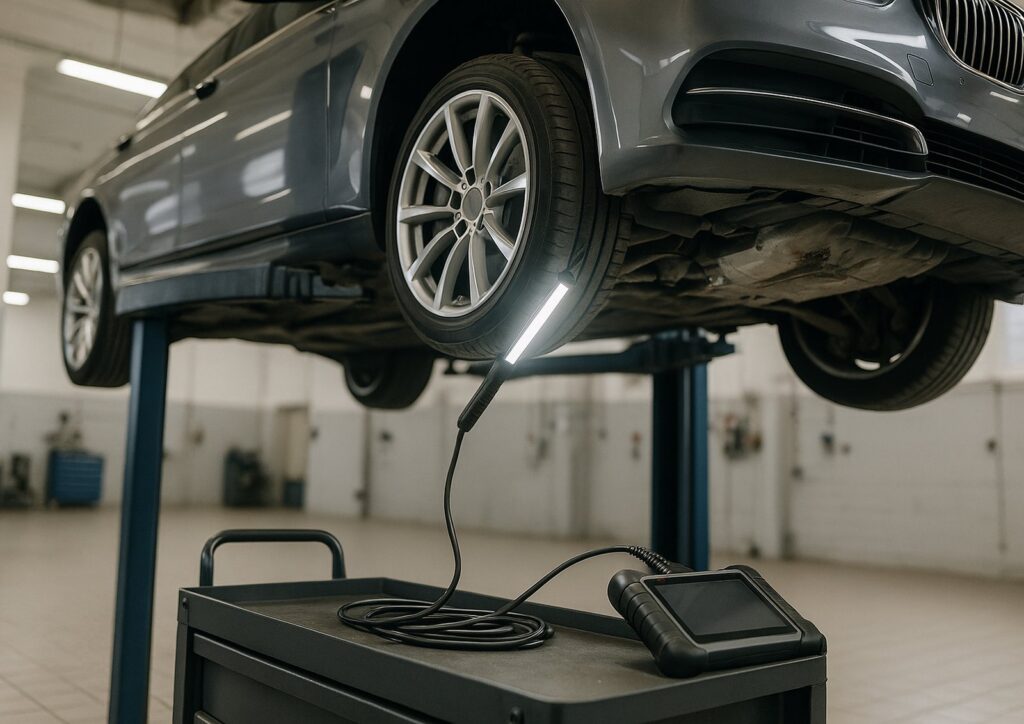
Audi diagnostics at an independent repair shop in Jacksonville.
How Audi’s Check Engine Light System Actually Works
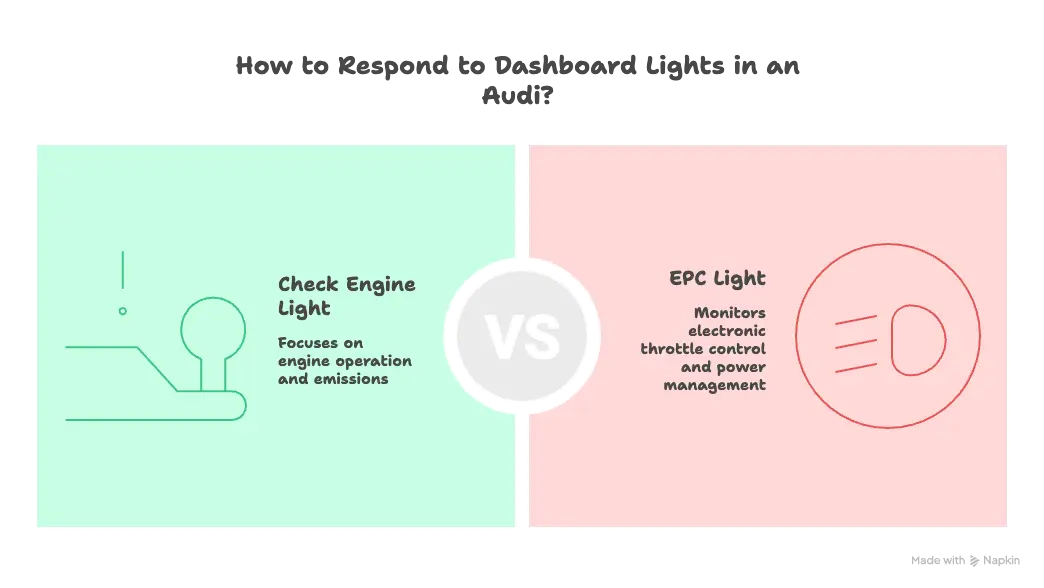
Audi’s check engine light is driven by the engine control module, which constantly monitors combustion, airflow, fuel delivery, emissions, and timing. The light does not come on after a single irregular reading. Instead, the system looks for patterns, repeat events, and operating conditions that confirm a real fault.
Audi also classifies faults by severity. Some codes are stored silently and only appear during a diagnostic scan. Others trigger the check engine light once the fault repeats under similar driving conditions. A flashing light indicates an active misfire or critical condition that can damage the engine or catalytic converters if driving continues.
What makes Audi different is how much data is attached to each fault. The system records when the problem occurred, how often it happened, and what the engine was doing at the time. Without access to this detailed fault data, it is easy to misdiagnose the issue or fix the symptom instead of the cause.
10 Common Audi Check Engine Light Causes and What They Mean
1. Ignition Coil and Spark Plug Failures
Ignition-related faults are among the most common reasons an Audi check engine light turns on. Audi engines are sensitive to ignition performance, especially turbocharged platforms like the 2.0T and 3.0T.
Worn spark plugs or failing coil packs cause incomplete combustion. When this happens, the engine control module detects misfires and logs fault codes tied to specific cylinders. At first, you may only notice rough idle, hesitation, or reduced fuel efficiency.
If the problem continues, the check engine light may begin flashing. This signals active misfires that can overheat catalytic converters and damage internal engine components. On many Audis, ignition faults also trigger secondary codes that confuse diagnosis if the root cause is not addressed first.
Most times, it appears shortly after routine service due to incorrect spark plug gaps, non-OEM plugs, or loosely seated coil connectors. Proper diagnosis confirms whether the fault is electrical, mechanical, or installation-related before parts are replaced.
2. Carbon Buildup on Intake Valves (Direct Injection Engines)
Carbon buildup is a well-documented issue on Audi’s direct injection engines, particularly the 2.0T and 3.0T platforms. Because fuel is injected directly into the combustion chamber, the intake valves no longer receive the cleaning effect of fuel washing over them.
Over time, oil vapors from the PCV system stick to the intake valves and harden into carbon deposits. As airflow becomes restricted, the engine struggles to maintain proper air-to-fuel ratios. The engine control module detects this imbalance and triggers the check engine light.
Early signs include cold-start misfires, rough idle, hesitation under load, and reduced throttle response. If ignored, carbon buildup can lead to repeated misfire codes, poor fuel economy, and increased stress on ignition components. A diagnostic scan often shows misfires across multiple cylinders, which is a key indicator that the issue is airflow-related rather than ignition-specific.
3. EVAP System Leaks and Purge Valve Faults
EVAP system faults are another frequent cause of an Audi check engine light. The EVAP system is responsible for capturing fuel vapors and routing them back into the engine for combustion. Even a small leak can trigger a fault.
Common issues include failing purge valves, cracked vacuum lines, or leaks under the intake manifold. These problems often produce codes like small or large EVAP leaks, which may not affect drivability at first. Many Audi owners only notice the check engine light without any change in how the car feels.
Over time, EVAP faults can lead to hard starts, fuel odor, or rough idle. Because EVAP components are buried in the engine bay on many Audi models, proper diagnosis is critical. Replacing parts without confirming the leak location often leads to repeat failures and unnecessary costs.
4. Camshaft Adjuster and Variable Valve Timing Faults
Audi engines rely heavily on variable valve timing to balance performance, fuel efficiency, and emissions. When camshaft adjusters or VVT solenoids begin to fail, the engine can no longer control valve timing accurately.
These faults often appear as rough running, hesitation during acceleration, or delayed throttle response. The check engine light comes on when the engine control module detects timing deviations outside acceptable limits. Codes related to camshaft position or timing correlation are common indicators.
In many cases, the issue is oil-related. Sludge buildup, incorrect oil viscosity, or extended oil change intervals reduce oil pressure to the adjusters. If ignored, timing faults can escalate into chain stretch or mechanical timing damage, which turns a manageable repair into a major one.
5. Secondary Air Injection System Failures
Secondary air injection faults usually trigger a steady check engine light shortly after a cold start. This system runs briefly when the engine is cold to reduce emissions, so the fault often appears even though the car drives normally once warmed up.
Over time, carbon buildup inside the cylinder head can block air passages, or the air pump and valves can fail. If ignored, the fault becomes permanent and harder to repair, especially once internal passages are restricted and external component replacement no longer resolves the issue.
6. Fuel Pressure and Fuel Delivery Problems
Fuel pressure faults often cause a steady or recurring check engine light, sometimes accompanied by hesitation or hard starts. The engine control unit monitors both low-pressure and high-pressure fuel systems closely, so even short drops in pressure are logged as faults.
These issues may involve failing fuel pumps, pressure sensors, or injectors. Continued driving with fuel delivery problems can create lean conditions, which increase combustion temperatures and raise the risk of piston, valve, or catalytic converter damage.
7. Oxygen Sensor and Air-Fuel Ratio Sensor Failures
Oxygen sensor failures typically cause a steady check engine light that may come and go over time. These sensors provide constant feedback for fuel adjustment, so slow or inaccurate readings lead the system to correct in the wrong direction.
As the sensor degrades, fuel economy drops and drivability suffers. Because the failure is gradual, the light often appears intermittently before becoming permanent, which leads many owners to delay diagnosis until performance noticeably declines.
7. Oxygen Sensor and Air-Fuel Ratio Sensor Failures
Oxygen sensor failures typically cause a steady check engine light that may come and go over time. These sensors provide constant feedback for fuel adjustment, so slow or inaccurate readings lead the system to correct in the wrong direction.
As the sensor degrades, fuel economy drops and drivability suffers. Because the failure is gradual, the light often appears intermittently before becoming permanent, which leads many owners to delay diagnosis until performance noticeably declines.
9. Exhaust Valve and Actuator Electrical Faults
Exhaust valve actuator issues often cause a steady check engine light without obvious drivability symptoms. These valves are electronically monitored, so electrical resistance or communication faults are detected quickly.
Problems often appear after exhaust modifications, corrosion at the actuator connector, or internal motor failure. While the car may feel normal at first, leaving the fault unresolved can lead to stuck valves and additional exhaust system damage.
9. Exhaust Valve and Actuator Electrical Faults
Exhaust valve actuator issues often cause a steady check engine light without obvious drivability symptoms. These valves are electronically monitored, so electrical resistance or communication faults are detected quickly.
Problems often appear after exhaust modifications, corrosion at the actuator connector, or internal motor failure. While the car may feel normal at first, leaving the fault unresolved can lead to stuck valves and additional exhaust system damage.
The Only Reliable Way to Diagnose an Audi Check Engine Light
An Audi check engine light is not vague or random. It is precise, data-driven, and tied to how the car monitors performance, emissions, and engine safety. When diagnosed correctly, most issues can be addressed early, before they turn into expensive mechanical failures.
That accuracy only comes from Audi-specific diagnostic tools. Generic scanners cannot read fault frequency, operating conditions, or module-level data. At Southside Euro, we use VCDS (VAG-COM) to perform full-system scans, access Audi control modules, and pinpoint the exact cause of the fault. This allows us to identify whether the issue is ignition-related, airflow-related, timing-related, or software-based, without unnecessary part replacement.
If your Audi needs answers, book a diagnostic appointment with our Jacksonville team today.