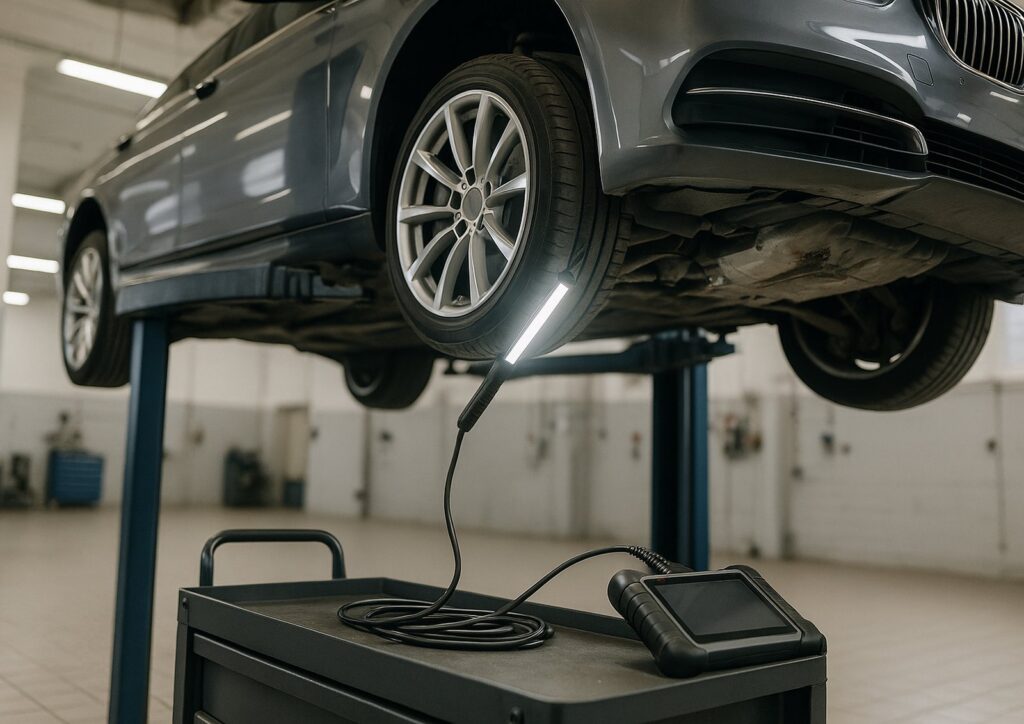














If your German car’s air conditioning has started blowing lukewarm air during a Jacksonville heat wave, you are not alone, and you are almost certainly not imagining it. BMW AC compressor failure is one of the most common warm-weather repairs we see on European vehicles in Northeast Florida, and Audi units fail in nearly identical patterns once the cars cross the 80,000-mile mark. The combination of triple-digit heat indices, brutal humidity, and salt-laden coastal air puts a unique workload on these systems that the original engineers in Munich and Ingolstadt did not always design around. Understanding how the compressor works, why it dies early in this climate, and what symptoms to catch before a $600 part turns into a $3,000 system flush will save you money and probably save your weekend. This guide walks through the diagnosis process the way a shop technician approaches it, with model-specific notes for the BMW and Audi platforms most common on Jacksonville roads.
How a BMW or Audi AC Compressor Actually Works
Before diving into failure modes, it helps to understand what is spinning under the hood. The AC compressor is a belt-driven pump that pressurizes refrigerant (R-134a on most pre-2017 European cars, R-1234yf on newer models) and circulates it through the evaporator, condenser, and expansion valve. When the system calls for cooling, the compressor engages, draws low-pressure refrigerant vapor from the evaporator, compresses it to roughly 200 to 300 PSI, and sends it forward as a hot, high-pressure gas. That gas dumps heat through the condenser at the front of the car, condenses to liquid, expands back to vapor through the expansion valve, and absorbs cabin heat at the evaporator. The cycle repeats hundreds of times per minute when you’re sitting at a red light on Beach Boulevard in August.

European manufacturers use two fundamentally different compressor designs, and they fail in very different ways. The older clutch-type compressor, common on E90 3-series, early A4 platforms, and most Volkswagens through the mid-2010s, uses an electromagnetic clutch on the pulley. When the climate control module sends 12 volts to the clutch coil, it engages the compressor. You can hear it click on and off. The clutch coil itself is a wear item, and the bearing inside the pulley spins constantly even when the clutch is disengaged.
The newer variable displacement compressor, found on most BMW models from roughly 2011 forward (F30, F10, F25, F15) and most modern Audis (B8.5 A4, C7 A6, 8R Q5, 4M Q7), runs continuously whenever the engine is on. There is no clutch. Instead, an internal control valve adjusts the swash plate angle to vary how much refrigerant the compressor pumps per revolution. At idle on a hot day, displacement is high; cruising on I-95 with the cabin already cool, displacement drops near zero. This design is quieter, smoother, and more fuel-efficient, but when it fails it almost always seizes catastrophically and contaminates the entire system with metal debris.
Why Florida Heat & Humidity Kill European AC Compressors Faster
A BMW sold in Munich might run its compressor twenty days a year at moderate load. The same car in Jacksonville is cycling at 80 to 100 percent capacity for six straight months, often eight if you count the shoulder seasons. That difference in duty cycle compounds across every component in the system. Compressor seals dry out from constant thermal cycling between a soaked-out parking lot and a cold cabin. Refrigerant oil breaks down faster at sustained high temperatures, losing its ability to lubricate the swash plate or piston rings inside the compressor. Even the condenser fans run more hours per year, which accelerates wear in the cooling pack and forces head pressures higher than the system was designed for.
Humidity is the silent killer most owners overlook. Ambient air at 70 percent relative humidity carries roughly four times the latent heat load of dry desert air at the same temperature. The evaporator has to condense all that moisture out of the cabin air before it can actually cool anything, which means the compressor pulls down harder and longer to hit setpoint. Drivers who park outside in the Jacksonville sun then crank the AC to maximum the moment they get in are essentially running their compressor through a thermal stress test every single afternoon.
Salt is the third factor, and it matters most for anyone living in Atlantic Beach, Neptune Beach, Jacksonville Beach, or anywhere within a few miles of the ocean. Salt-laden coastal air corrodes the aluminum AC line fittings and the compressor’s metal mounting points. Once corrosion starts at a fitting, it weakens the o-ring sealing surface and refrigerant slowly migrates out. Low refrigerant means the compressor runs without enough oil circulation, which kills it from the inside.
Top Symptoms of AC Compressor Failure
BMW AC compressor symptoms rarely appear all at once. The system usually warns you for weeks or months before total failure, and catching the early signs is the difference between a clutch coil replacement and a full system rebuild. Here are the warning signs in roughly the order they typically appear.
1. Intermittent loss of cold air. The vents blow cold for fifteen minutes, then warm air for five, then cold again. On clutch-style compressors, this usually points to a failing clutch coil that loses contact when it gets heat-soaked. On variable displacement units, it often signals a control valve that is starting to stick. Either way, this is your earliest warning, and it almost always shows up first in heavy stop-and-go traffic when underhood temperatures peak.
2. Warm air at idle, cool air at highway speed. If your BMW AC is not blowing cold while you’re sitting still but recovers above 40 mph, the compressor likely cannot generate enough flow at low RPM. This points to internal wear, low refrigerant charge, or both. Newer N20 and N55 BMWs are especially prone to this because the auxiliary electric coolant pump and the radiator fans share thermal management duties with the AC system.
3. Audible clicking, grinding, or whining from the front of the engine. A rapid rhythmic click from the compressor area on a clutch-style unit usually means the clutch is engaging and disengaging because the system pressure is out of range. Grinding or metallic whining means the internal bearings or pistons are failing. Once you hear actual grinding, the compressor is on borrowed time, often days rather than weeks.
4. Visible refrigerant leaks or oily residue. Pop the hood and look at the AC lines, especially where they connect to the compressor and the receiver/dryer. Refrigerant oil leaves a dark, slightly tacky film around any leak point. UV dye inspection makes these leaks obvious under a black light.
5. Check Engine Light or climate control fault codes. Modern European cars throw codes when the AC pressure transducer detects abnormal readings or when the compressor draws excessive current. Common codes include BMW’s 2E81 (refrigerant pressure plausibility), 2E82 (refrigerant pressure too low), and Audi’s 00819 (AC pressure switch sensor). The MIL doesn’t always come on, but the codes are stored.
6. AC compressor will not engage at all. Total no-engagement on a clutch-style system points to a dead clutch coil, blown fuse, or pressure switch lockout from low refrigerant. On a variable displacement compressor, the climate control module simply reports no cooling and you’ll see warm air with no compressor noise change.
7. Burning smell or smoke from the engine bay. A seized compressor pulley can scorch the serpentine belt within minutes. If you smell hot rubber and the AC just stopped working, shut the car off. A snapped belt on most BMW and Audi platforms also disables the water pump, alternator, and power steering, which can lead to overheating and engine damage in a matter of miles.
Common BMW Model-Specific AC Compressor Failures
E90 / E92 3-Series (2006-2013)
The E90 platform is a workhorse, but the Denso 7SEU17C compressor used on N52, N51, and N54 engines has a well-documented clutch coil failure pattern between 70,000 and 110,000 miles. The first symptom is usually a loud snap-buzz from the front of the engine on hot days, followed by total loss of cooling. We see this fail repeatedly on E90 335i models around the 90k mark, and the smarter repair on these is to replace the entire compressor rather than just the clutch assembly, because the clutch alone runs nearly $400 in parts and the labor overlap is significant.
F30 3-Series and F32 4-Series (2012-2019)
The F30 platform moved to a variable displacement design that is generally more reliable than the E90 unit, but the control valve in the back of the compressor is sensitive to refrigerant contamination. Cars that have been topped off at quick-lube shops with mystery refrigerant or sealant products almost always end up needing full compressor replacement. We’ve also seen a recurring issue on 2013-2015 F30 328i models where the high-pressure line near the firewall develops a slow leak from corrosion at the crimped fitting.
F10 5-Series (2011-2016)
F10 535i and 550i models suffer from the same variable displacement compressor issues as the F30, plus an extra wrinkle: the auxiliary electric water pump sits very close to the compressor in the engine bay and creates a heat pocket that accelerates seal failure. Expect compressor replacement at 100k to 130k miles on F10 platforms in Florida, often paired with condenser replacement because the original aluminum condenser corrodes from the inside out in salt air environments.
X3 (F25, 2011-2017) and X5 (E70/F15, 2007-2018)
SUV platforms tend to fail earlier than sedans because they spend more time in low-speed, high-load conditions like stop-and-go traffic, beach trips with the AC blasting, and driveway warmups. F25 X3 35i models with the N55 engine commonly need compressor work between 80k and 110k miles. E70 X5 models, especially the 4.8i and xDrive50i variants, push close to the front of the failure curve because the V8 engine bay runs hotter and the AC system has more line length to pressurize.
Common Audi Model-Specific AC Compressor Failures
A4 B8 (2009-2016)
The B8 A4 with the 2.0T engine uses a Sanden compressor that develops a characteristic squealing noise when the front bearing starts to fail, usually somewhere between 90k and 130k miles. Audi AC not working complaints on this generation are about half compressor and half evaporator/expansion valve issues, and proper diagnosis requires manifold gauges plus a scan tool that can read live AC system data through the climate control module. The 3.2 V6 variant fails earlier, often at 75k to 100k miles.
A6 C7 (2012-2018)
The C7 A6 is one of the more reliable Audi platforms overall, but the supercharged 3.0T version puts substantial heat load on the front of the engine, and the AC compressor sits directly beneath the supercharger discharge. We routinely see audi ac compressor replacement on these cars between 100k and 140k miles, and the job is significantly more labor-intensive than the BMW equivalent because the front clip has to be moved into service position to reach the compressor cleanly.
Q5 (8R, 2009-2017)
The 8R Q5 is the Audi equivalent of the BMW X3 in terms of failure patterns. Compressor replacement is common in the 90k to 120k mile window. The 2.0T Q5 also has a known issue with the AC pressure sensor wiring connector developing corrosion at the firewall pass-through, which throws fault codes that mimic compressor failure but are actually a $40 fix once correctly diagnosed.
Q7 (4L, 2007-2015 and 4M, 2017+)
The first-generation 4L Q7 is notorious for AC system trouble. The compressor itself fails, but more frequently we see condenser failures, expansion valve clogs, and refrigerant leaks at the rear AC lines that route under the vehicle to the rear evaporator. Florida Q7 owners should expect significant AC system maintenance starting around 100k miles. The 4M generation is much improved but still benefits from annual system inspection given the climate.
DIY Diagnostic Checks Versus When to Bring It In
There are a handful of checks any reasonably handy owner can do at home before deciding whether to call a shop. Start with the obvious: does the compressor clutch engage when the AC is turned on? On clutch-style systems, you can see the center of the pulley begin to spin with the engine running. If it never engages, check the AC fuse first (consult the owner’s manual for location), then verify the cabin temperature setting is actually calling for cold air rather than auto mode that’s defaulting to fan-only.
Next, check the refrigerant charge with a basic AC manifold gauge set if you have one, or with a low-side pressure gauge from any auto parts store. With the engine running, AC on max, and the compressor engaged, low-side pressure should read between 25 and 45 PSI on a properly charged R-134a system at about 80 degrees ambient. Below 25 PSI usually means low refrigerant charge or a stuck expansion valve. Above 60 PSI suggests the compressor is not pulling vacuum effectively, which points to internal wear.
Listen carefully at idle with the AC on max and the hood open. A healthy compressor produces a steady hum. Clicking, knocking, or grinding means internal damage. Look at the serpentine belt for any signs of glazing, fraying, or oily contamination from a leaking seal at the compressor snout.
That’s about as far as DIY should reasonably go on a modern European car. Recovering and recharging refrigerant requires EPA-certified equipment by federal law, and accurately diagnosing variable displacement compressors requires a factory-level scan tool that can command the control valve and read live pressure data through the climate control module. If your basic checks suggest the system is low or the compressor is making noise, that’s the point to bring it to a shop with proper European diagnostic equipment. Trying to top off a system with parts-store cans of refrigerant plus stop-leak almost always makes the eventual repair more expensive, because sealant products contaminate the compressor, the expansion valve, and the receiver/dryer, often requiring a full system flush.
Repair Versus Replace Decisions and Realistic Jacksonville Cost Ranges
The right repair depends entirely on what failed and how the system was treated before failure. A simple clutch coil replacement on an older E90 or B8 A4 runs roughly $450 to $750 out the door at most independent European shops in Jacksonville, including parts, labor, refrigerant recovery, and recharge. That’s the cheap end of the spectrum and it only applies to clutch-style compressors where the rest of the unit is still healthy.
Full compressor replacement on a clutch-style BMW or Audi typically runs $1,100 to $1,800 depending on model, parts source (OEM Denso or Sanden versus quality aftermarket from Behr or Nissens), and whether the receiver/dryer needs replacement at the same time. The receiver/dryer should always be replaced when you open the system for major work, because the desiccant inside absorbs moisture quickly once exposed to humid Florida air.
Variable displacement compressor replacement on later F-chassis BMWs and modern Audis runs $1,400 to $2,400 for a straightforward job. If the original compressor seized and contaminated the system with metal debris, you also need a full system flush, condenser replacement (you cannot reliably flush an aluminum parallel-flow condenser), and expansion valve replacement, which can push the total job to $2,800 to $3,500. This is the worst-case scenario and it’s almost always preventable by acting on early warning signs rather than driving until total failure. At Southside Euro in Jacksonville, we see this larger repair most frequently on cars that had refrigerant sealant added at quick-lube chains or that were driven for weeks with obvious symptoms before the owner brought them in.
The repair-versus-replace decision usually comes down to two questions: how old is the rest of the AC system, and how long do you plan to keep the car? A 60,000-mile F30 with a failed clutch coil makes obvious sense to repair. A 180,000-mile X5 with a seized compressor, corroded condenser, and a leaking rear evaporator line might be a $4,000 job that exceeds what the owner wants to invest. Honest diagnosis upfront prevents either over-repair or wasted money on a system that is going to fail again in six months from a different component.