













If you own a BMW, Audi, Mercedes, Porsche, or any European car in Jacksonville, you have probably noticed your battery does not last as long as the salesman promised. European car battery drain is one of the most common no-start complaints we see, and Florida’s climate is the biggest reason why. A battery in Michigan might cruise along four or five years; the same battery in a Jacksonville driveway often gives up in 24 to 36 months. This guide breaks down why your European car eats batteries faster than your neighbor’s Toyota, what warning signs to watch for, and what you can do about it before you find yourself stranded in the Publix parking lot at 7 PM.
Why Florida Heat Destroys European Car Batteries Faster Than the National Average
The U.S. Department of Energy and most battery manufacturers cite a national average lifespan of four to five years for a quality lead-acid or AGM battery. In Florida, that number collapses to two to three years. The reason is straightforward chemistry: heat accelerates the chemical reactions inside a battery, and those reactions are not all good ones.

When ambient temps hover above 95 degrees for months, three things happen inside your battery case. First, the electrolyte evaporates faster, even in sealed AGM units, because safety vents release pressure when internal temps spike. Second, the lead plates corrode and shed active material at roughly double the rate they would in a temperate climate. Third, internal resistance climbs as the plates degrade, meaning the battery works harder to deliver the same cranking amps.
Underhood temperatures in a Jacksonville BMW or Mercedes can easily hit 180 to 220 degrees Fahrenheit during summer driving, and heat soak keeps the battery cooking for an hour after you park. For every 15 degrees above 77 degrees Fahrenheit, battery life is cut roughly in half. Run that math against a Florida summer and you understand why a “5-year warranty” battery from the parts store is really a 30-month battery in our climate.
How European Cars Put More Load on Batteries Than Domestic Vehicles
A 2010 Chevy Silverado has roughly a dozen electronic control modules. A 2020 BMW 540i (G30) has more than 80. Audi A6 and A7 platforms (C8) run similar module counts, and the Mercedes E-Class (W213) is right there with them. Every one of those modules sits on a CAN bus or FlexRay network, and many of them never fully sleep, even when the car is locked and parked.
Here is what is pulling current on a typical late-model European car at 2 AM in your driveway:
- Telematics module (BMW ConnectedDrive, Audi connect, Mercedes me) phoning home every few hours
- Comfort access / keyless entry antennas constantly scanning for the key fob
- Tire pressure monitoring receivers
- Alarm and tilt sensors
- Body control modules monitoring door switches and trunk latches
- Infotainment in standby waiting for a wake signal
- Battery management system itself, polling state-of-charge
A healthy European car typically draws 30 to 50 milliamps once everything has gone to sleep, which takes 20 to 45 minutes after lockup. A 2015 Toyota Camry might draw 15 mA. Over a week sitting at the airport, the European car will pull 8 to 12 amp-hours from the battery, while the Toyota pulls maybe 2.5 amp-hours. Add 100-degree heat, and the European car fights accelerated self-discharge on top of that parasitic load.
Start-Stop Systems Make It Worse
Most BMW models from 2011 onward, Audi platforms since 2012, and the bulk of the Mercedes lineup have auto start-stop. This system shuts the engine off at red lights and restarts it when you lift off the brake. Each restart is harder on the battery than a normal cold start because the engine is hot and accessories like the AC compressor are still spinning. To survive this duty cycle, these cars require AGM (Absorbed Glass Mat) or EFB (Enhanced Flooded Battery) construction, both of which are significantly more sensitive to heat than standard flooded lead-acid.
Top Warning Signs Your European Car Battery Is Failing
Modern European cars rarely give you a slow, dramatic crank before they die. The symptoms are electronic and weird, because modules start browning out before the starter has any trouble. Here is what to watch for if your bmw battery dies fast or your mercedes battery problems are worsening:
Electronic Glitches and Reset Symptoms
- Infotainment reboots mid-drive. The iDrive screen on a BMW F30 or G20 going black and rebooting is a classic low-voltage symptom.
- Start-stop suddenly disabled. The orange “Auto Start-Stop unavailable” message in your dash means the BMS has decided the battery is too weak to support a restart.
- Phantom warning lights. ABS, traction control, parking sensor, and tire pressure warnings appearing simultaneously and then clearing are textbook voltage drop symptoms.
- Memory seats forgetting positions. Comfort presets, mirror angles, and HVAC settings resetting to default after the car sits overnight.
- Power tailgate moving slowly. The rear hatch on a Q5, X3, or GLC opening at half speed is a battery telling you it is done.
- Windows dropping out of frameless door tracks. Coupe windows that “auto-drop” when you open the door but fail to seal when you close it.
Cranking Symptoms
By the time you actually hear a slow crank, the battery is usually past the point of recovery. A healthy AGM battery should spin a hot V6 or V8 over with a crisp, fast crank that sounds nearly identical at 7 AM as it does at 7 PM. If the morning crank sounds noticeably slower than the afternoon crank, the battery is losing its reserve capacity.
Parasitic Drain: What It Is and How to Hunt It Down
Parasitic battery drain is current draw on the battery while the car is off and locked. As we covered earlier, every modern car has some baseline drain, but problems start when something refuses to go to sleep. On European cars, the usual suspects include:
- Aftermarket dash cams hardwired to the fuse box
- Failed amplifier or DSP module that keeps the audio bus awake
- Stuck trunk latch microswitch fooling the car into thinking the trunk is open
- Glovebox or vanity mirror lights stuck on
- Failed comfort access antenna constantly transmitting
- Telematics module that will not hand off to sleep mode (common on 2014-2018 BMW F-chassis cars)
- Aftermarket alarm or remote start installed by a previous owner
How a Shop Tests for Parasitic Drain
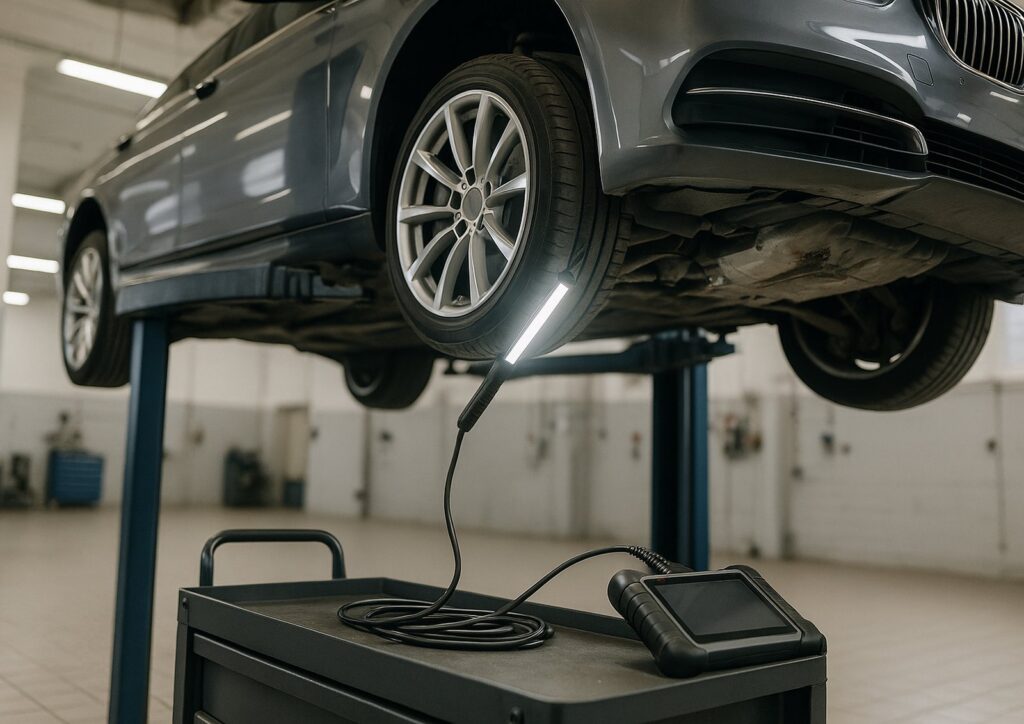
You cannot just pop the negative cable and clamp an ammeter inline, because disconnecting the battery wakes every module on the bus. The professional method uses an inductive low-current amp clamp around the battery cable, allowing measurement without breaking the circuit. We let the car sit 60 minutes after lockup, then read the draw. Anything over 80 mA on a fully asleep car warrants investigation. From there it is a process of pulling fuses one at a time and watching the current drop. A real parasitic drain diagnosis is a 2 to 4 hour job and typically runs $250 to $500.
Why You Can’t Just Swap Any Battery in a BMW, Audi, or Mercedes
This is where a lot of DIY jobs go sideways and why so many drivers end up at our door after a parts store install. European cars from roughly 2002 onward have an Intelligent Battery Sensor (IBS) bolted to the negative terminal that monitors voltage, current, temperature, and state-of-health. The car’s battery management system uses that data to control charging voltage, start-stop activation, and load shedding.
When you install a new battery, the BMS does not automatically know. It still thinks the battery is the worn-out unit it has been managing for years, so it continues sending the wrong charging profile. Within months, that brand-new battery is being either chronically undercharged or cooked, and the cycle starts again.
BMW AGM Battery Coding
Every BMW from the E60 5-Series and E90 3-Series forward requires battery registration. On older E-chassis cars, this is done with INPA, ISTA, or a quality scan tool through the DME. On F-chassis (F30, F10, F15) and newer G-chassis cars, it must be done through ISTA+. The procedure tells the BMS the new battery’s part number, capacity, manufacture date, and serial number. Without it, the car will eventually code “battery discharged” faults and disable comfort features.
Mercedes SBC and Battery Reset
Mercedes vehicles on the W211, W212, W213, W164, and newer platforms require a battery reset through Xentry/DAS to clear stored data and re-initialize the BMS. Models with auxiliary batteries (S-Class, GL/GLS, AMG with start-stop) require both units to be coded. Skipping this on a W213 E-Class will cause comfort access and air suspension to act erratically within weeks.
Audi Battery Management System
Audi vehicles on the MQB and MLB Evo platforms (current A4, A5, A6, A7, Q5, Q7, Q8) require battery coding through VCDS, ODIS, or VAG-COM. The energy management module needs the new battery’s serial number and capacity rating. Without it, your audi battery replacement will not deliver the lifespan you paid for, and the system will continue dropping comfort loads thinking the old battery is still installed.
This is where Southside Euro sees the most preventable damage. A driver replaces the battery at a chain store, drives off happy, and 18 months later is back to square one because nobody coded the new unit. Coding takes 10 to 20 minutes and prevents thousands in downstream electrical headaches.
AGM vs EFB vs Lead-Acid: Which Battery Does Your Car Actually Need?
One of the most common mistakes we see is a driver replacing an AGM battery with a cheaper flooded lead-acid unit because the parts store said it would “fit.” It will fit. It will also fail in 8 to 14 months and possibly damage your alternator or DC-DC converter in the process.
AGM (Absorbed Glass Mat)
AGM batteries hold the electrolyte in fiberglass mats between the lead plates. They are sealed, vibration-resistant, can be mounted at angles (important for BMW and Audi trunk installations), and tolerate the deep-discharge cycles that come with start-stop. Required for virtually every BMW from 2011 forward, all Audi models with start-stop, most Mercedes from 2014 forward, and any Porsche with the PASM or PCCB option packages. Expect to pay $280 to $550 installed and coded.
EFB (Enhanced Flooded Battery)
EFB sits between standard flooded and AGM in both performance and price, using thicker plates and a special separator to handle moderate start-stop duty. Common in entry-level Volkswagens (Jetta, Tiguan), some base-model Audis, and a few Mini variants. Typical cost is $180 to $280 installed.
Standard Flooded Lead-Acid
Found mostly in older European cars without start-stop (pre-2010 BMW E46/E39, older Mercedes W210/W211, Audi B6/B7) and some entry-level Volvos. If your car was originally equipped with a flooded battery, do not “upgrade” to AGM without verifying the alternator and BMS can handle it.
7 Prevention Tips for Florida European Car Owners
You cannot stop the heat, but you can absolutely stretch your battery life from “barely 2 years” to a solid 4 years with some discipline. These are the habits we recommend to every customer who drives a european car battery-equipped vehicle in the Jacksonville area.
1. Park in the Shade or a Garage
The single highest-impact change you can make. Underhood temperatures in a sun-baked car can hit 180 degrees; the same car in shade stays under 130. Even a carport or a shaded section of your work parking lot makes a measurable difference.
2. Drive At Least 20 Minutes Twice a Week
Short trips never let the alternator fully recharge what the starter pulled. Five-minute hops to the gas station are battery killers. If you mostly use rideshare and only drive on weekends, your battery is being slowly murdered.
3. Use a Battery Tender for Cars That Sit
If you have a weekend Porsche, project car, or vehicle that sits more than 7 days, plug in a CTEK MXS 5.0, NOCO Genius 10, or comparable smart maintainer. They will not overcharge your AGM and keep the BMS happy. About $80 to $200 and they pay for themselves the first time they save a battery.
4. Disconnect the Battery for Long Storage
Going on a 3-week vacation? Either plug in a tender or pull the negative terminal. You will need to re-sync windows, sunroof, and possibly comfort access after reconnection, but it beats a dead battery and a tow bill.
5. Have the Battery Load-Tested Annually
A voltage reading tells you almost nothing. A proper conductance test (Midtronics or similar) measures actual CCA and state-of-health, and can predict failure 6 to 12 months out. Most quality shops, including Southside Euro, will perform this test for free during any service visit.
6. Keep the Battery Terminals Clean and Tight
Florida humidity plus battery acid vapor equals corrosion. White or blue-green crust on terminals adds resistance and reduces charging efficiency. A wire brush, baking soda, and water clean it up; dielectric grease slows it down.
7. Address Parasitic Draws Promptly
If you have added a dash cam, aftermarket stereo, remote start, or any accessory that taps into the electrical system, have it audited. A poorly installed dash cam alone can pull 200 mA continuously, draining a healthy battery in under a week.
When to Replace the Battery vs When to Chase the Drain
Drivers often ask whether they should just keep replacing batteries every couple of years or actually find the underlying problem. The answer depends on the symptoms.
Replace the battery if:
- The battery is more than 3 years old (or more than 2 years in Florida)
- A conductance test shows CCA below 75 percent of rated value
- The car cranks slowly even after a long drive
- You have been hit with multiple jump-starts in a short window (each deep discharge permanently reduces capacity by 5 to 10 percent)
Chase the drain if:
- You replaced the battery less than 18 months ago and it is already weak
- The car dies after 3 to 5 days of sitting, even with a known-good battery
- You hear modules clicking or fans running long after lock-up
- The amp clamp shows over 100 mA an hour after the car was locked
A new battery runs $300 to $600 installed and coded on most German cars; a parasitic drain diagnosis is $250 to $500. If you are killing batteries faster than every 24 months, the diagnosis is the cheaper move. Throwing parts at the problem is how people spend $2,000 in 4 years on what should have been one $400 fix.
The Bottom Line for Jacksonville European Car Owners
European cars are engineered assuming the battery is maintained, the climate is moderate, and the tech installing replacements has the tools to code them properly. None of those assumptions hold in Florida. Heat shortens battery life by half, electronics demand more from the battery than ever, and most quick-lube places have no idea what battery registration even is. With the right battery, proper coding, and a few habit changes, your BMW, Audi, Mercedes, or Porsche can absolutely make it through Jacksonville summers without leaving you stranded. If you are seeing any of the warning signs above, get the battery and charging system tested before you need a tow truck.