













You are merging onto I-295 near Southside, you ask for a little throttle, and the car hesitates instead of pulling. A yellow message lights the cluster: Drivetrain Malfunction. If you own a BMW in Jacksonville, a bmw drivetrain malfunction warning is one of the most common alerts we see roll through the shop, and it is also one of the most misunderstood.
The good news: the message itself is usually the car protecting itself, not the car falling apart. The frustrating part: “Drivetrain Malfunction” is a catch-all that can point to a dozen different underlying issues, from a tired ignition coil to a struggling high-pressure fuel pump. Guessing your way through it is where owners get into trouble.

This guide walks through what the warning actually means, why turbo BMWs in Northeast Florida trigger it more than most, what is safe to drive versus what should be pulled over immediately, and how a proper diagnosis saves you from throwing parts at a car that does not need them.
What a BMW drivetrain malfunction message actually means
“Drivetrain Malfunction” is not a specific part failure. It is the engine control unit (ECU, or DME in BMW terms) telling you it has detected a fault serious enough that it is now deliberately limiting the engine to protect it. The moment the DME sees a reading it does not trust, it pulls back timing, cuts boost, and in many cases drops the car into what most people call limp mode.
In practical terms, you feel reduced power: the car may cap out around 3,000 to 4,000 RPM, throttle response goes soft, and the transmission may hold a lower gear. That is the DME choosing “get home slowly and safely” over “make full power and risk serious internal damage.” A bmw drivetrain malfunction reduced power event is the software equivalent of the car limping to the sideline instead of blowing out its knee.
Because the message is a symptom rather than a diagnosis, the only way to know what actually tripped it is to read the stored fault codes from the DME. The warning light tells you the car flinched. The codes tell you why.
The common triggers on turbo BMWs
The N20, N26, N54, N55, B46, B48, and B58 engines that fill Jacksonville driveways are almost all turbocharged and direct-injected. That design makes big, smooth power, but it also creates a handful of usual suspects behind a bmw drivetrain malfunction. Here are the ones we chase most often:
- Ignition coils and spark plugs. The single most common trigger. A weak coil causes a misfire, the DME detects it, and it throttles back to protect the catalytic converters. On turbo engines the plugs are under real cylinder pressure, so worn plugs fail sooner than owners expect.
- Fuel injectors. A leaking or clogged bmw fuel injector throws off the air-fuel mixture, causing lean or rich faults and misfires. Direct injectors live in a harsh, high-pressure environment and are a frequent culprit.
- High-pressure fuel pump (HPFP). The HPFP feeds the direct-injection system. When it starts to fail it cannot maintain rail pressure under load, the DME sees the shortfall, and the car goes into limp mode, usually right when you accelerate hard.
- Boost, wastegate, and charge-pipe issues. A bmw turbo that cannot hit commanded boost, a rattling wastegate, or a cracked plastic charge pipe blowing boost pressure will all trip an overboost or underboost fault.
- VANOS (variable valve timing). Sticking VANOS solenoids or worn seals push cam timing out of range, and the DME flags it.
- Sensors. Camshaft and crankshaft position sensors, the MAF, the MAP, and oxygen sensors all feed the DME. A single bad sensor can trigger the whole warning even when the mechanical parts are healthy.
Notice how many of these produce the exact same dashboard message. A misfire from a coil and a pressure shortfall from the HPFP can feel nearly identical from the driver’s seat, which is precisely why reading codes beats guessing.
Is it safe to keep driving? Limp home versus stop now
This is the question every owner asks first, and the honest answer is: it depends on how the car behaves and whether other warnings appear alongside the drivetrain message. Limp mode exists so you can get somewhere safe. It is not a license to keep driving indefinitely.
| What you notice | What it usually suggests | What to do |
|---|---|---|
| Reduced power only, engine runs smooth, no other lights | Sensor or mild misfire; DME is being cautious | Limp home gently, then get it scanned soon |
| Drivetrain message plus rough shaking or stumbling | Active misfire dumping raw fuel into the exhaust | Drive only a short distance; avoid heavy throttle |
| Drivetrain message with a whoosh or loud hiss under throttle | Blown charge pipe or boost leak | Safe to limp home slowly, no hard acceleration |
| Any red warning, temperature spike, or oil-pressure light | Cooling, lubrication, or serious mechanical fault | Pull over safely and stop; do not keep driving |
| Message plus grinding, knocking, or burning smell | Potential internal or turbo damage | Stop and arrange transport, do not drive |
The rule of thumb: a lone yellow drivetrain message with smooth (if weak) running usually means you can baby the car home at low load. The moment you add heat, shaking, a red light, or any noise or smell that was not there before, treat it as a stop-now situation. Continuing to drive a misfiring engine can wash the catalytic converters and turn a simple coil job into a much larger repair. If you are ever unsure, the safest move is to stop and call us before you make it worse.
Why Jacksonville’s climate and fuel make it worse
A bmw drivetrain malfunction is not purely a Florida problem, but our conditions in Duval, St. Johns, Clay, and Nassau counties absolutely accelerate the failures behind it. Three local factors stand out.
Heat. Northeast Florida runs hot and humid from May well into October, and underhood temperatures on a turbo BMW crawling through summer traffic on Butler Boulevard or Roosevelt are brutal. That constant heat cycling bakes rubber boost hoses, embrittles plastic charge pipes and valve covers, and shortens the life of ignition components. Parts that might last for years in a mild climate give up sooner here.
Ethanol fuel. Most pump gas in the Jacksonville area is E10, blended with up to ten percent ethanol. Ethanol attracts moisture and burns differently than straight gasoline, and in a high-pressure direct-injection system it is harder on injectors and fuel pumps over time. Combine that with the phase separation that can happen in a tank left sitting through humid weather, and fuel-side faults become more common.
Short trips. A lot of local driving is exactly the kind that engines hate: a quick run to the Town Center, a hop across the bridge, a school drop-off in San Marco. Short trips never let the engine fully heat-soak and burn off deposits, so carbon builds on the intake valves of direct-injected BMWs, fuel dilutes the oil, and misfire-triggering deposits accumulate faster.
That last point connects directly to another issue we treat constantly. Carbon buildup on intake valves is a leading cause of the rough running and misfires that trip the drivetrain warning, and we cover the fix in detail in our guide to walnut blasting for carbon buildup on BMW, Audi, and Mercedes. Heat also punishes the cooling system, and an overheating engine will absolutely throw a drivetrain fault, which is why it is worth knowing the signs your European car’s cooling system is about to fail before it strands you.
Diagnosis: reading the fault codes the right way
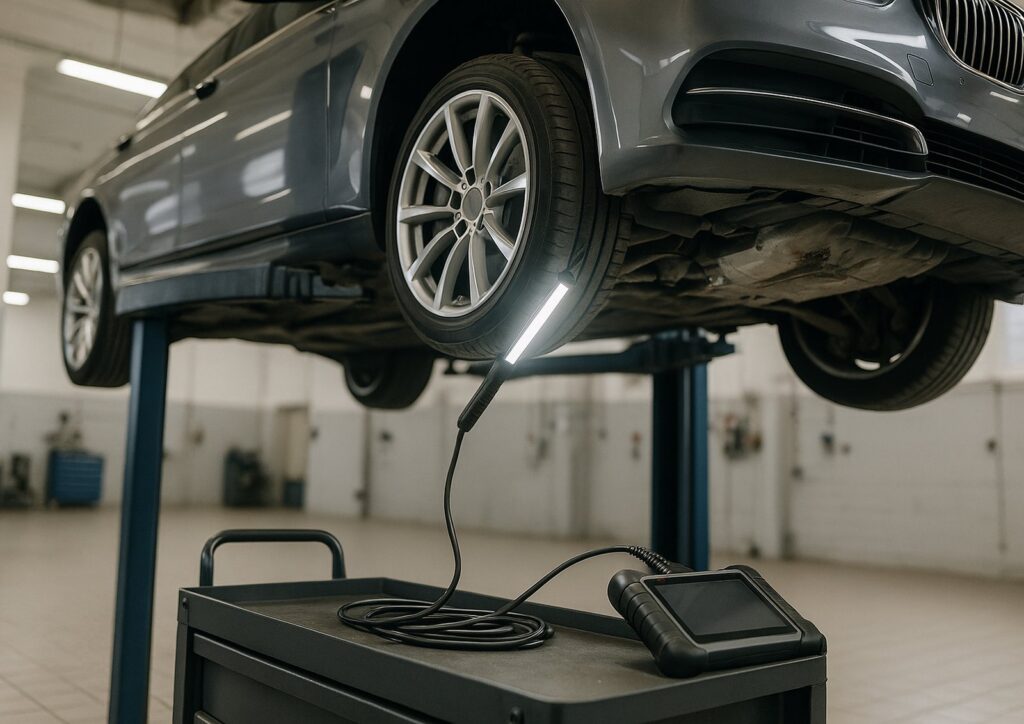
Here is the part that separates a real fix from a guessing game. When the drivetrain message appears, the DME stores one or more fault codes describing what it saw. A proper diagnosis starts by pulling those codes with a scan tool that speaks BMW’s language, not a generic parts-store reader that only shows basic emissions codes.
BMW-specific diagnostics let a technician see the manufacturer fault codes, freeze-frame data from the moment the fault set, and live values while the engine runs. That means we can watch commanded boost against actual boost, see which cylinder is misfiring, monitor fuel rail pressure, and check VANOS timing in real time. The codes narrow the field; the live data confirms the actual cause.
From there, testing is targeted. If codes point at a misfire on cylinder three, we test that coil, that plug, and that injector rather than replacing all six of everything. If the data shows a boost shortfall, we pressure-test the intake tract to find the leak. The goal is to prove the cause before replacing anything.
Why guessing at parts is the mistake that wastes time and trust
Because so many different faults produce the identical drivetrain message, the temptation is to start swapping the usual suspects and hope. That approach fails owners in two ways. First, you can replace a perfectly good coil, injector, or even a turbo and still have the warning return the next day because the real cause was never identified. Second, driving on an unresolved misfire while you experiment can damage the catalytic converters and, in a worst case, harm the turbo or the engine internals.
The bmw drivetrain malfunction reduced power state is the car giving you a window to fix it correctly before something breaks for good. Spending an hour on a proper diagnosis first almost always resolves the problem in one visit instead of three. It is the difference between “we replaced the failed coil and cleared the fault” and “we replaced four things hoping one would stick.”
A good independent European shop treats the drivetrain warning as a starting clue, not a verdict. Read the codes, verify with live data, test the specific component, confirm the fix, and clear the fault so it stays gone. That is the whole game.
What to do the moment the warning appears
If you see “Drivetrain Malfunction” light up on your commute, here is a calm, practical sequence:
- Ease off the throttle. Don’t try to power through it. Let the car settle into its reduced-power state.
- Check for other warnings. A lone yellow message is very different from a red temperature or oil light. Red means stop.
- Get to a safe spot. If the car is shaking, smells hot, or makes new noises, pull over safely rather than pushing on.
- Try a full restart if you are stopped safely. Sometimes a full key-off cycle clears a transient sensor glitch and restores power. If it comes right back, the fault is real and needs codes read.
- Avoid heavy loads. No hard acceleration, no towing, no highway sprints until it is diagnosed.
- Book a scan promptly. Even if the message clears, the code is stored. Reading it while the evidence is fresh makes the diagnosis faster and more accurate.
Most drivers who follow those steps make it home fine and get the car looked at on their own schedule. The owners who run into real trouble are usually the ones who kept flogging a misfiring engine because it “still drove okay.”