












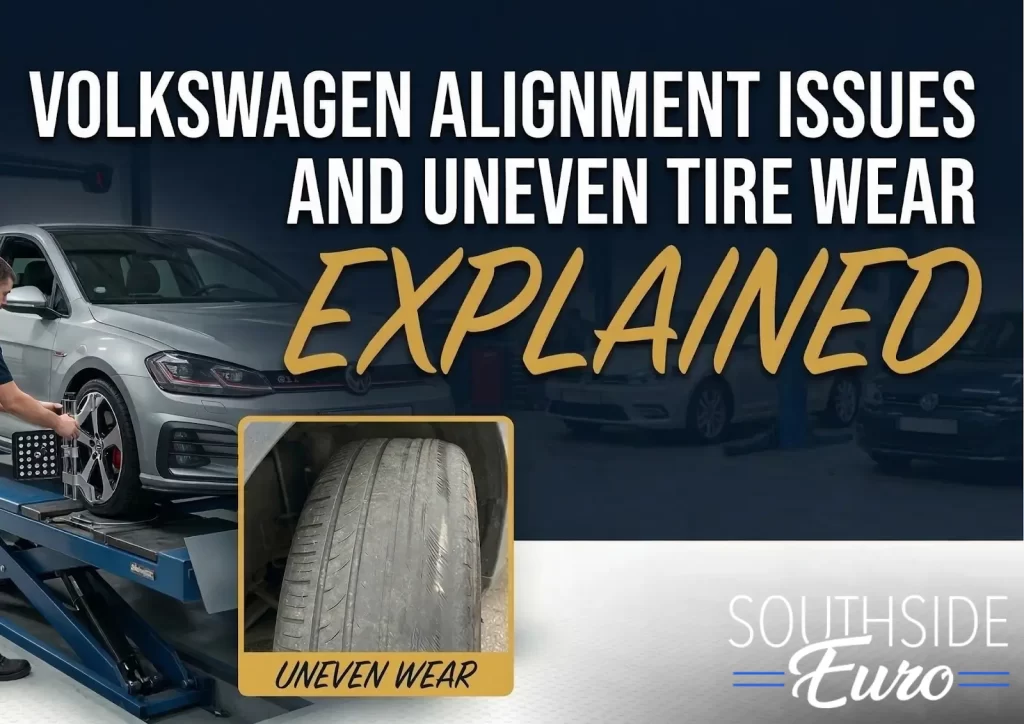
Volkswagen owners frequently encounter rapid tire wear requiring replacement every 20,000-30,000 miles instead of the expected 40,000-60,000 miles. This premature wear isn’t caused by tire quality issues, it results from specific suspension design characteristics and component wear patterns unique to VW vehicles.
Understanding why Volkswagen alignment changes occur and recognizing the warning signs helps owners address problems before destroying expensive tires and damaging suspension components. This comprehensive analysis explains the engineering factors, common failure points, and proper maintenance strategies for VW alignment and tire longevity.

Volkswagen Suspension Design Fundamentals
MacPherson Strut Front Suspension
Most Volkswagen models employ MacPherson strut front suspension offering compact design suitable for front-wheel-drive and AWD layouts, good ride quality and handling balance, and cost-effective manufacturing.
However, this creates alignment sensitivity where limited adjustability requires suspension geometry remaining within tight tolerances, worn components quickly affect camber and caster, and control arm bushings directly influence toe angle.
Common VW applications include Golf, GTI, R, Jetta, GLI, Passat, Tiguan, and Atlas models.
Multi-Link Rear Suspension
Volkswagen’s rear suspension typically uses multi-link design providing independent rear suspension with excellent handling, separate control of camber, toe, and caster adjustments, and comfortable ride quality.
This creates alignment sensitivity through multiple bushings and pivot points creating numerous wear locations, rear toe changes dramatically with bushing wear, and camber adjustability limited without aftermarket components.
4Motion AWD Complications
Volkswagen’s 4Motion all-wheel-drive system adds alignment complexity. Driveline preload means AWD system creates constant torque through drivetrain, suspension bushings experience different loading than FWD models, and accelerated bushing wear occurs particularly in rear suspension.
Propshaft angle sensitivity means rear suspension height affects propshaft angles, incorrect alignment or worn springs change driveline geometry, creating vibration and accelerating component wear.
Common VW Tire Wear Patterns and Their Causes
Inner Edge Wear (Excessive Negative Camber)
The most common Volkswagen tire wear pattern shows severe wear on inside edge while outside remains relatively new.
Appearance and Causes
Inside 2-3 inches of tread completely worn to wear bars appears while outside tread depth still measures 6/32″ or more with smooth, feathered appearance on inside edge.
This results from control arm bushing deterioration. VW control arms use large rubber bushings connecting arms to subframe. These bushings wear and allow excessive movement where bushing deflection allows camber to go more negative under load, particularly severe during cornering, with progressive wear accelerating after 60,000-80,000 miles.
Specific Bushing Failures
Rear lower control arm bushings are most common, with oval-shaped bushings compressing and tearing internally, allowing rear wheels to tilt inward excessively, and creating severe inside edge wear on rear tires.
Front lower control arm bushings see large bushings prone to splitting and deflection, allowing front wheels to tilt inward during braking and cornering, and accelerating wear on inside edges of front tires.
Lowered Suspension Issues
Aftermarket lowering springs or coilovers often create excessive negative camber beyond adjustable range, requiring camber adjustment hardware to correct. Without correction, tires are destroyed in 10,000-15,000 miles.
Factory camber specifications out of tolerance affect some VW models from factory having aggressive negative camber designed for sporty handling. While acceptable for performance driving, this accelerates tire wear. Owners can request dealer adjust to less aggressive settings within spec range.
Outer Edge Wear (Excessive Positive Camber)
Less common but still occurs, particularly after impacts. Outside 2-3 inches worn significantly more than inside appears with center tread relatively normal depth and scuffing or cupping on outside edge.
Primary Causes
Impact damage to suspension from pothole or curb impact bends control arms or struts, creating positive camber where wheel tilts outward and requiring damaged component replacement.
Worn strut mounts see upper strut mount bearing failure allow strut to tilt, changing camber angle substantially. Front tires show outer edge wear often accompanied by clunking over bumps.
Incorrect ride height results from worn springs allowing vehicle to sag, with excessive positive camber resulting from lowered ride height and requiring spring replacement and alignment.
Center Wear (Overinflation)
Distinctive wear pattern with center of tread worn while edges remain good shows center 50% of tread worn significantly, edge tread relatively normal, and smooth wear pattern across center.
This results from chronic overinflation running pressures 5+ PSI above specification. Tire center contacts road while edges lift slightly. VW recommended pressures typically range 32-38 PSI depending on model.
Incorrect tire size also contributes, where installing narrow tires on wide wheels creates excessive crown in tread with center wearing prematurely.
Feathering (Incorrect Toe)
Distinct sawtooth wear pattern appears as tread blocks worn at angles, smooth on one side with sharp edge on other, and running hand across tread feels rough in one direction.
Toe Misalignment Patterns
Excessive toe-in sees tires pointed inward more than specification, creating inside feathering and causing squealing during turns.
Excessive toe-out has tires pointed outward, creating outside feathering while vehicle wanders and requires constant steering correction.
VW-Specific Toe Issues
Rear toe sensitivity means VW rear suspension is extremely sensitive to toe angle, bushing wear causes rapid toe changes, and rear toe misalignment causes front tire feathering through vehicle being pushed sideways.
Rack and pinion wear sees steering rack internal wear allow tie rod position changes, front toe varies with steering position, and creates inconsistent feathering pattern.
Cupping or Scalloping
Wavy, cup-shaped wear depressions around tire circumference appear as high and low spots around tire, typically with 3-4 inch spacing between depressions, creating noise and vibration.
Causes include shock absorber failure where worn shocks allow wheel to bounce, tire contacts pavement inconsistently, and creates rhythmic wear pattern.
Wheel bearing wear with excessive bearing play allows wheel wobble. VW front wheel bearings pressed into knuckle require knuckle replacement or bearing installation tool.
Tire imbalance through significant imbalance creates harmonic vibration, vibration causes irregular wear pattern, and VW wheel balance specifications are very tight (0.25 oz max).
Bent wheel not running true (out of round) creates similar symptoms to imbalance and requires wheel replacement.
VW-Specific Alignment Challenges
Limited Camber Adjustability
Most Volkswagen models offer minimal camber adjustment capability from factory.
Front Camber Limitations
MacPherson strut design is typically non-adjustable, with camber set by control arm position and strut mount installation. Aftermarket camber plates are required for adjustment range.
Rear Camber Constraints
Multi-link suspension offers camber bolts on some models with adjustment range typically only ±0.5-1.0 degrees, insufficient to correct wear from lowered vehicles.
Implications for Owners
When suspension components wear or vehicle is lowered, camber may fall outside acceptable range with no factory adjustment method available. Options include aftermarket camber arms replacing stock control arms with adjustable versions at $400-$800 per axle, camber bolts/plates allowing adjustment at specific mounting points at $100-$300 installed, and shims and eccentric bolts enabling small adjustments at $50-$150 installed.
Rear Toe Adjustment Complexity
VW multi-link rear suspension provides excellent toe adjustability but requires expertise.
Multiple Adjustment Points
Toe is adjustable at several control arm mounting locations, but incorrect adjustment technique causes binding and can create preload in bushings reducing their service life.
Bushing Condition Effects
Worn bushings prevent achieving proper toe settings. Alignment technician may achieve specification on rack, but vehicle drives off rack and toe changes as bushings deflect.
Proper Procedure Requirements
Proper alignment demands inspecting all bushings before alignment, replacing worn components first, performing alignment with vehicle at ride height not on lift, and road testing to verify settings after alignment.
Subframe Position Influence
VW vehicles use front and rear subframes mounting suspension components where subframe position is critical. Subframe mounts to body with multiple bolts, position affects all suspension geometry, and impact damage or improper installation shifts subframe.
Shifted Subframe Symptoms
Alignment specifications become unachievable, steering wheel sits off-center with front wheels straight, vehicle pulls despite correct alignment readings, and uneven tire wear persists despite proper alignment numbers.
Correction Process
Requires subframe measurement and repositioning using specialized equipment measuring subframe position. Technicians loosen mounts, shift subframe to correct position, and retighten with labor cost of $300-$600 beyond standard alignment.
Suspension Components That Affect Alignment
Control Arm Bushings: The Primary Culprit
VW control arm bushings represent the most common cause of alignment-related tire wear.
Front Lower Control Arm Bushings
Located where control arms mount to front subframe, these large oval bushings subject to tremendous stress support vehicle weight and absorb braking forces with wear accelerating after 60,000-80,000 miles.
Failure symptoms include clunking over bumps, steering wheel vibration during braking, inner edge tire wear on front tires, and vehicle doesn’t track straight.
Replacement cost involves bushings only (pressed into existing arms) at $300-$500 or complete control arms with bushings at $500-$800 plus alignment required after replacement at $150-$200.
Rear Lower Control Arm Bushings
Most common cause of rear tire wear includes four bushings per side on multi-link suspension, particularly problematic on AWD models, with wear creating excessive negative camber and toe changes.
Failure symptoms show severe inner edge wear on rear tires, vehicle feels unstable over bumps, rear end seems to wander, and clunking from rear suspension.
Replacement cost per side runs lower control arm bushings at $400-$700, often requires replacing multiple arms at $800-$1,500 per side, plus alignment required at $150-$200.
Strut Mounts and Bearings
Upper strut mounts serve multiple functions including supporting vehicle weight through strut, allowing strut to compress and rebound, providing bearing in mount allowing strut to rotate during steering, and maintaining mount position that determines camber and caster.
Failure Symptoms
Worn mount allows unwanted movement creating clunking when turning at low speeds, steering doesn’t return to center, camber falls out of specification, and uneven front tire wear develops.
Replacement timing suggests proactively replacing when replacing struts and replacing independently if showing failure symptoms by 80,000-100,000 miles.
Tie Rod Ends
Tie rods connect steering rack to steering knuckles. Inner tie rod connects to steering rack with sealed boot protecting from contamination, while failure causes play in steering. Outer tie rod connects to steering knuckle with ball joint allowing vertical suspension movement, where wear affects toe angle directly.
Failure symptoms include excessive steering wheel play, feathered tire wear, squealing during turns, and vehicle doesn’t track straight.
Replacement timing involves inspection during every alignment, replacing when play detected, with typical lifespan of 80,000-120,000 miles.
Wheel Bearings
VW front wheel bearings pressed into steering knuckles feature non-serviceable sealed bearings with replacement requiring special tools or knuckle replacement. Failure is more common on GTI, R, and other performance models.
Failure symptoms include humming or grinding noise increasing with speed, vibration through steering wheel, loose feeling when driving, and uneven tire wear from wheel wobble.
Replacement complexity means bearing pressed into knuckle requires hydraulic press, with many shops replacing entire knuckle assembly instead. This requires wheel alignment after replacement.
VW Model-Specific Alignment Issues
MK7 Golf/GTI (2015-2021)
Common problems include rear lower control arm bushing failure occurring between 50,000-70,000 miles, creating severe inner edge tire wear, and requiring both rear lower control arms at $800-$1,200.
Front control arm bushing wear develops after 60,000-80,000 miles, creating clunking and steering vibration, with both front lower control arms costing $500-$800.
Recommended service involves inspecting rear bushings at every alignment starting at 50,000 miles, replacing proactively at first signs of wear, which saves tires and prevents secondary damage.
B8 Passat (2012-2019)
Common problems include rear upper control arm bushings failing prematurely creating rear toe issues, causing severe rear tire feathering, with both rear upper control arms costing $700-$1,000.
Front strut mounts develop clunking by 70,000-80,000 miles, allowing excessive camber changes, with both front strut mounts costing $300-$500.
Subframe position sees subframe bolts loosen over time, creating alignment problems that cannot be corrected, and requiring subframe measurement and repositioning at $400-$700.
Tiguan (2009-2017)
Common problems with AWD rear suspension wear see 4Motion system stress rear bushings significantly, with rear lower control arm bushings failing by 50,000-60,000 miles, creating inner edge wear pattern on rear tires, and both rear lower control arms costing $900-$1,400.
Front lower control arms see ball joints and bushings fail earlier than FWD models, causing clunking and irregular tire wear, with both front lower control arms costing $600-$900.
Wheel bearing failures occur more commonly on Tiguan than other VW models, creating vibration and uneven tire wear, with front wheel bearing replacement at $350-$600 per side.
Jetta (All generations)
Common problems include rear beam suspension (non-independent) on older Jetta models using beam rear suspension with very limited alignment adjustability, requiring shims for camber/toe correction at $150-$300.
Front control arm bushings wear faster on Jetta due to budget suspension design, creating clunking and steering problems, with both front lower control arms costing $400-$700.
The True Cost of Ignoring Alignment Problems
Scenario 1: Proactive Maintenance
At 60,000 miles, owner notices slight inner edge wear during tire rotation. Inspection reveals early rear control arm bushing wear.
Action taken includes replacing both rear lower control arms at $900 and four-wheel alignment at $180 for total of $1,080.
Result sees tire wear normalize, tires last full 50,000-mile lifespan, and no secondary suspension damage occurs.
Scenario 2: Delayed Repair
At 60,000 miles, owner notices inner edge wear but decides to “wait and see.” At 65,000 miles, inner edge wear accelerates with bushings deteriorating rapidly. At 70,000 miles, rear tires worn to wear bars on inside edge despite only 10,000 miles since installation.
Cost accumulation includes premature tire replacement (4 tires) at $800, both rear lower control arms (now severely worn) at $900, four-wheel alignment at $180, and wheel bearing replacement (damaged by misalignment) at $400 for total of $2,280.
Additional consequences include safety risk from reduced tire traction, vehicle handling compromised, and more extensive suspension wear from misalignment.
The delayed repair costs over twice as much and creates safety concerns.
Proper VW Alignment Specifications
Understanding Alignment Angles
Camber represents vertical tilt of wheel when viewed from front. Negative camber means top of wheel tilts inward while positive camber has top tilting outward.
VW typical specifications run front at -0.5° to -1.0° (slightly negative for handling) and rear at -1.0° to -1.5° (more negative for stability).
Caster shows forward/backward tilt of steering axis when viewed from side. More caster improves straight-line stability and affects steering effort and self-centering.
VW typical specifications place front at +4.0° to +6.0° (positive for stability), though it’s not adjustable on most models without modifications.
Toe indicates direction wheels point when viewed from above. Toe-in means wheels point slightly inward while toe-out has wheels pointing slightly outward.
VW typical specifications set front at 0° to +0.10° total (slight toe-in) and rear at 0° to +0.20° total (slight toe-in).
Why Specifications Matter
Alignment angles outside specification by even small amounts create tire wear. Camber 1° beyond spec creates noticeable edge wear within 5,000-10,000 miles with severe wear by 15,000-20,000 miles.
Toe 0.2° beyond spec creates feathering within 3,000-5,000 miles with severe feathering and noise by 10,000 miles.
Combined misalignment where both camber and toe are incorrect creates rapid compound wear, with tires potentially needing replacement in as little as 10,000-15,000 miles.
Alignment Service Best Practices
When Alignment is Required
Alignment becomes necessary after any suspension work including control arm replacement, strut replacement, any bushing replacement, and spring replacement.
After tire replacement, verify alignment before installing new tires to prevent destroying new tires with existing misalignment.
When symptoms appear including uneven tire wear, vehicle pulls to one side, steering wheel off-center, or vehicle wanders and doesn’t track straight, immediate alignment is needed.
Regular intervals every 12,000-15,000 miles preventively catches small changes before tire damage occurs.
What Proper Alignment Includes
Pre-alignment inspection checks all suspension components for wear, measures tire tread depth and wear patterns, verifies proper tire pressure, and includes test drive to assess symptoms.
Four-wheel alignment measures and adjusts front and rear axles, accounts for AWD driveline preload, and verifies thrust angle (rear axle parallel to centerline).
Road test verification follows alignment with test drive, verifies straight-line tracking, confirms steering wheel centered, and checks for pulls or wanders.
Documentation includes before and after measurements, printout showing all angles within specification, and technician notes on any issues found.
Professional VW Alignment Service at Southside Euro
Specialized VW Expertise
Our Volkswagen specialists understand VW-specific alignment challenges and common failure patterns. We’ve performed thousands of VW alignments since 2019 on Golf, GTI, Golf R, Jetta, GLI, Passat, Tiguan, Atlas, and Arteon models.
Comprehensive Pre-Alignment Inspection
Before performing alignment, we thoroughly inspect all control arm bushings front and rear, strut mounts and bearings, tie rod ends inner and outer, wheel bearings for play, springs and shocks for wear, and subframe position if previous alignment issues exist.
This inspection identifies worn components that must be replaced before alignment. Performing alignment with worn parts wastes money as the alignment won’t hold and tire wear continues.
State-of-the-Art Alignment Equipment
We use computerized Hunter alignment systems with four-wheel alignment capability, rolling compensation to account for rim runout, thrust angle measurement, subframe position verification, and before and after documentation.
Proper Specifications for Modified Vehicles
Lowered or modified VW vehicles require adjusted alignment specs. Lowered vehicles have more negative camber from lowered ride height, requiring adjustment to most positive settings within range, potentially needing aftermarket camber adjustment hardware, and aggressive toe specs set to minimize feathering.
Performance vehicles use more aggressive camber for cornering grip as acceptable trade-off of faster tire wear for improved handling. We discuss performance versus longevity trade-offs with owners.
Jacksonville’s VW Alignment Specialists
Located at 4583 Sunbeam Rd., Jacksonville, FL 32257, Southside Euro provides expert VW suspension and alignment services.
Don’t let alignment problems destroy your tires. Call (904) 240-1440 to schedule a comprehensive alignment inspection today. We’ll identify worn components, perform proper alignment, and protect your tire investment.