













Why Is My BMW Burning Oil? Causes, Fixes & When to Worry
You just changed your oil 2,000 miles ago. The dipstick is already a quart low. There’s no puddle under the car, no visible leak on the driveway — but the oil is disappearing. If this sounds familiar, you’re not alone. Excessive oil consumption is one of the single most common complaints among BMW owners, and it affects nearly every generation and engine family to some degree.
But here’s what most owners don’t know: some oil consumption on a BMW is engineered into the design. The question isn’t whether your BMW uses oil — it’s whether it’s using too much. Let’s break down what’s normal, what’s not, and what the fixes look like.

What BMW Considers “Normal” Oil Consumption
BMW’s official position is that oil consumption of up to 1 quart per 750 miles is within acceptable parameters. That number surprises most owners — and frankly, most mechanics too. By comparison, most Japanese and American manufacturers consider anything over 1 quart per 3,000–5,000 miles to be excessive.
In practice, a healthy BMW engine should consume roughly 1 quart every 1,500–3,000 miles depending on driving style, engine variant, and age. If you’re adding oil more frequently than that, something is likely wearing out or failing.
The Engines Most Prone to Oil Consumption
| Engine | Found In | Oil Issue | Severity |
|---|---|---|---|
| N63 (Twin-Turbo V8) | 550i, 650i, 750i, X5 50i | Valve stem seals, turbo oil lines | 🔴 High |
| N54 (Twin-Turbo I6) | 335i, 535i, 135i | Turbo oil return lines, valve cover | 🟡 Moderate |
| N55 (Single-Turbo I6) | 335i, 435i, 535i, X3/X5 | Valve cover gasket, oil filter housing | 🟡 Moderate |
| S65 (V8, naturally aspirated) | E90/E92 M3 | Rod bearing wear, throttle actuator | 🔴 High |
| B58 (Single-Turbo I6) | 340i, 440i, M340i, Supra | Minimal — best in class | 🟢 Low |
The 5 Most Common Causes of BMW Oil Consumption
1. Valve Stem Seals
This is the #1 culprit on high-mileage BMWs, especially the N63 V8. Valve stem seals prevent oil from leaking past the valve guides into the combustion chamber. When they harden and crack — which happens naturally with heat cycling over time — oil seeps into the cylinders and burns during combustion. The telltale sign is a puff of blue-gray smoke on cold startup that clears after a few seconds. Replacement requires removing the cylinder head or using a specialized tool to replace seals in place, and typically costs $2,000–$4,000 depending on the engine.
2. Turbo Oil Seal Failure
Turbocharged BMWs (which is nearly all of them now) rely on oil-fed bearings inside the turbocharger. When the seals inside the turbo wear out, oil leaks into the intake or exhaust side. On the intake side, you’ll notice oily residue in the intercooler piping. On the exhaust side, you get blue smoke under boost. This is common on the N54 and early N55 engines, especially when oil change intervals are stretched.
3. Valve Cover Gasket Leaks
The valve cover gasket on most BMW inline-6 engines is made of rubber that hardens and shrinks over time. When it fails, oil seeps out onto the exhaust manifold and burns off — creating a burning oil smell without any visible puddle underneath. On N55 and N54 engines, the valve cover itself is made of plastic and can warp, requiring replacement of the entire valve cover assembly rather than just the gasket.
4. Oil Filter Housing Gasket
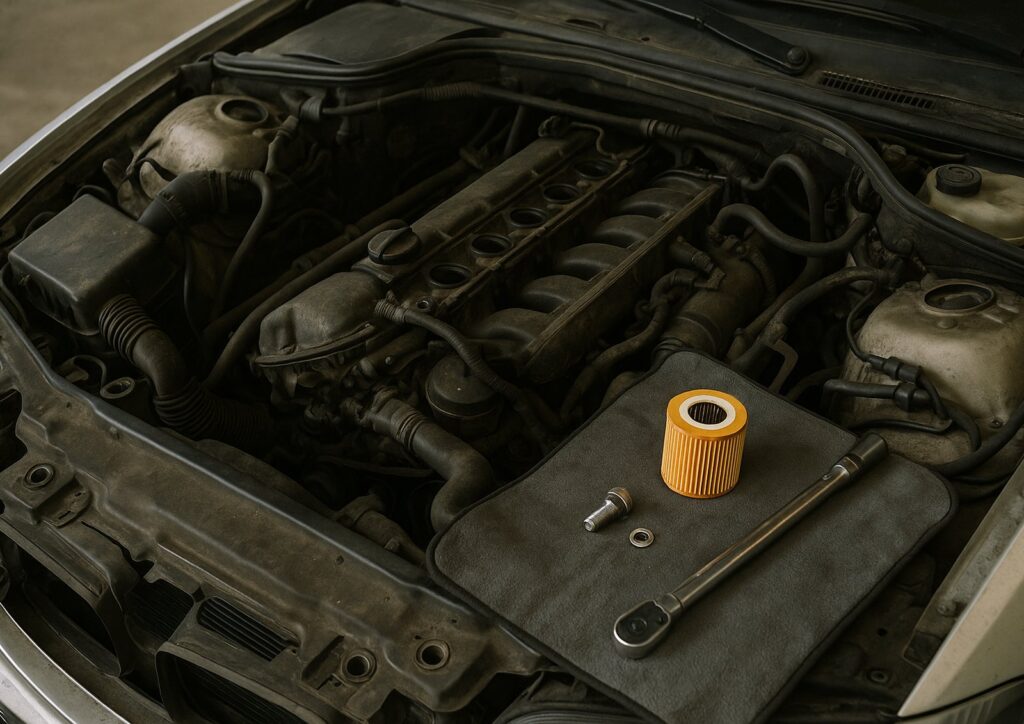
This is one of the most common oil leaks on BMW inline-6 engines. The oil filter housing sits right above the engine and has a large rubber gasket that deteriorates with heat. When it leaks, oil drips down the front of the engine block. It’s often misdiagnosed as a different leak because the oil travels along the block before dripping. This is a straightforward repair that most Euro specialists can handle in a few hours.
5. PCV (Crankcase Ventilation) System Failure
BMW’s crankcase ventilation system recirculates blow-by gases back into the intake. When the PCV valve or its associated diaphragm fails, excess pressure builds in the crankcase and pushes oil past seals and into the intake tract. Symptoms include rough idle, whistling noises from the engine, and increased oil consumption. On many BMW engines, the PCV system is integrated into the valve cover, so a valve cover replacement addresses both issues simultaneously.
When to Worry vs. When to Monitor
✅ Monitor — Probably Normal
• Using less than 1 quart per 1,500 miles with no smoke or leaks
• Oil level drops slightly between changes but stays above minimum
• No check engine lights or warning messages
❌ Get It Checked — Something’s Wrong
• Using more than 1 quart per 1,000 miles
• Blue or gray smoke from the exhaust, especially on cold start or under acceleration
• Burning oil smell from the engine bay
• Oil level warning light coming on between changes
• Oil residue in the intercooler piping or around the turbo
What Southside Euro Does Differently
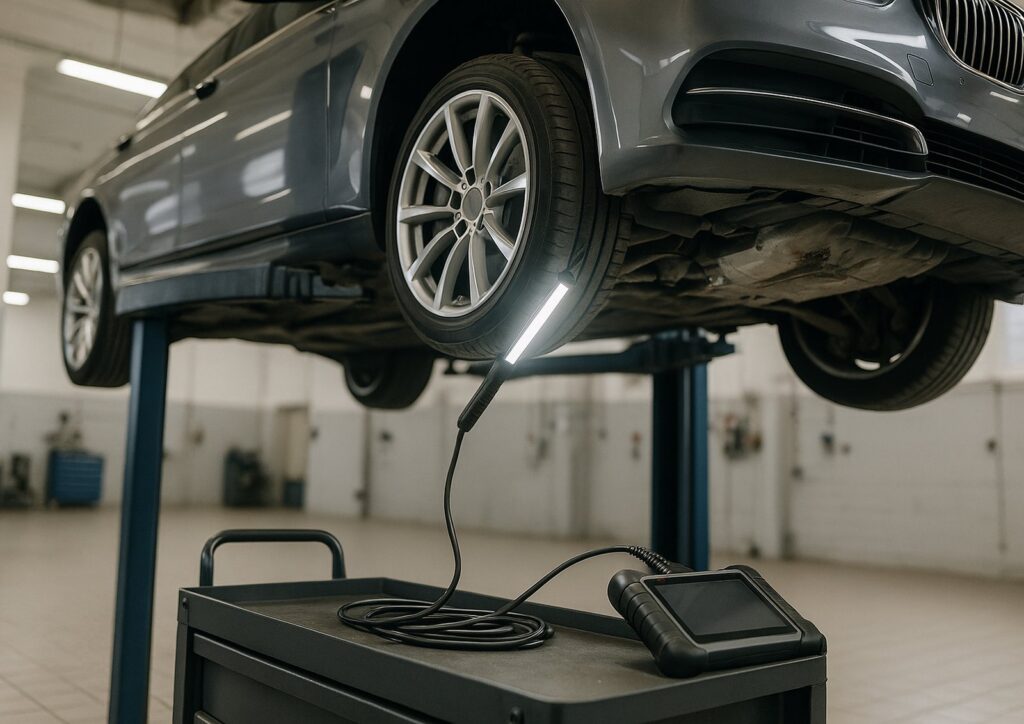
When a BMW comes in with an oil consumption complaint, we don’t just top it off and send you home. We perform a systematic diagnostic that includes a visual inspection for external leaks using UV dye if necessary, compression and leak-down testing to evaluate internal engine health, borescope inspection of the cylinders when warranted, turbo inspection for oil seal integrity, and PCV system testing.
This process identifies exactly where the oil is going — whether it’s burning internally, leaking externally, or both — so the repair targets the actual cause instead of guessing.
Stop Guessing, Start Diagnosing
If your BMW is using more oil than it should, the worst thing you can do is keep topping it off and hoping it doesn’t get worse. Oil consumption issues almost always get worse over time, and the longer you wait, the more expensive the repair becomes. Call Southside Euro at (904) 240-1440 for a diagnostic assessment. We’ll tell you exactly what’s happening and what it takes to fix it.
Southside Euro — Jacksonville’s most trusted European car specialist. BMW, Audi, Mercedes, VW, Porsche & more. (904) 240-1440
Frequently Asked Questions
Is it normal for a BMW to burn oil?
Some oil consumption is considered normal by BMW — up to 1 quart per 750 miles per their spec. In practice, a healthy BMW should use about 1 quart per 1,500–3,000 miles. Anything more than that warrants a diagnostic inspection.
How much does it cost to fix BMW oil consumption?
It depends on the cause. A valve cover gasket or oil filter housing gasket runs $400–$800. Valve stem seals cost $2,000–$4,000. Turbo seal replacement can range from $1,500–$3,500. A proper diagnostic identifies the exact cause so you’re not paying for unnecessary repairs.
Can I use thicker oil to reduce BMW oil consumption?
We don’t recommend it. BMW engines are engineered for specific oil viscosities (typically 5W-30 or 0W-20). Using thicker oil may mask consumption temporarily but can cause poor lubrication at cold start, increased fuel consumption, and catalytic converter damage. Fix the root cause instead.