













Summarize this article with:
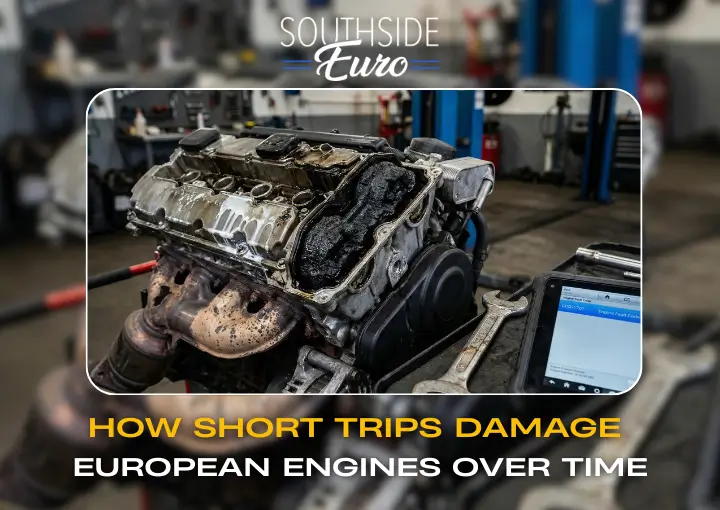
European vehicles deliver exceptional performance and efficiency on highway journeys and spirited drives, but they suffer significant mechanical stress during short trips that never allow components to reach proper operating temperatures.
The sophisticated engines in BMW, Mercedes-Benz, Audi, Porsche, Volkswagen, Jaguar, Land Rover, Volvo, Mini Cooper, Alfa Romeo, Maserati, and Rolls-Royce vehicles experience progressive damage when operated repeatedly for trips under 10 miles.

Jacksonville's
Most Trusted
Euro Car Shop
Book Your Appointment Today
This damage accumulates silently over months and years until catastrophic failures occur at 60,000-80,000 miles instead of the 150,000-200,000-mile lifespan these engines achieve with proper operating conditions.
The Thermal Cycle Stress on European Engine Components
Precision Engineering Requires Thermal Equilibrium
European engines use advanced materials and manufacturing processes that create incredibly tight tolerances between moving parts. Aluminum alloys in blocks and cylinder heads, forged steel crankshafts, and composite materials in intake manifolds all expand and contract at different rates during heating and cooling cycles.
The engineers design these components to operate at specific temperature equilibrium:
- Coolant temperature: Typically 190-220°F
- Engine oil temperature: Typically 210-240°F
Incomplete Thermal Cycles
Short trips prevent this thermal equilibrium from occurring. The engine starts cold, components begin expanding as combustion generates heat, but the trip ends before stable operating temperature is achieved.
The next cold start repeats this partial warm-up cycle. Over thousands of short trips, the repeated expansion and contraction cycles stress components differently than engines that heat to full temperature and maintain that temperature for extended periods.
Cylinder Head Gasket Vulnerability
Cylinder head gaskets in particular suffer from these thermal cycles. The gasket material compresses and relaxes with each thermal cycle, and incomplete heating cycles prevent the gasket from fully relaxing between cycles.
The cumulative stress causes microscopic gasket material failures that allow combustion gases to leak. BMW N20 and N26 engines commonly develop head gasket failures between 60,000-80,000 miles when subjected to predominantly short-trip driving, while the same engines driven primarily on highways often exceed 150,000 miles before gasket replacement becomes necessary.
Turbocharger Thermal Shock
Turbochargers experience extreme thermal stress during short trips. The turbine housing reaches temperatures exceeding 1,500°F even during moderate acceleration, while the compressor housing and bearing assembly remain relatively cool.
Shutting off the engine while components exist at these temperature extremes creates tremendous thermal shock. The oil remaining in the turbocharger’s bearing housing cooks and forms carbon deposits that restrict oil flow during subsequent startups.
Over hundreds of short trips, these deposits accumulate until the turbocharger bearings operate without adequate lubrication, causing catastrophic bearing failure.
Condensation and Moisture Accumulation Damage
Water as a Combustion Byproduct
Internal combustion engines produce water as a combustion byproduct, approximately one gallon of water for every gallon of fuel burned. During normal operation at full temperature, this water exits through the exhaust system as vapor.
However, during short trips where exhaust system components never exceed 200°F, the water condenses and accumulates in:
- Exhaust system components
- Catalytic converters
- Mufflers
- Exhaust manifolds
Acidic Condensation Corrosion
The condensation isn’t pure water, it contains acidic compounds formed from combustion byproducts:
- Sulfuric acid
- Nitric acid
- Carbonic acid
These acids corrode exhaust system components from the inside. Stainless steel exhaust systems in European vehicles resist external rust but corrode internally when exposed to acidic condensation.
Catalytic converters face particular vulnerability as the condensation attacks the ceramic substrate and precious metal catalyst coatings.
Crankcase Water Accumulation
Water also accumulates in the engine’s crankcase. Blow-by gases from the combustion chambers carry water vapor past the piston rings and into the crankcase.
The positive crankcase ventilation (PCV) system normally evacuates these gases, but the system operates most efficiently at full operating temperature. Short trips leave water vapor in the crankcase where it condenses as the engine cools.
The water mixes with engine oil, creating an emulsion that appears as:
- Milky residue on the dipstick
- White foam under the oil filler cap
Oil Emulsion Destruction
This oil/water emulsion destroys the oil’s lubricating properties:
- Oil viscosity changes
- Protective films between moving parts reduced
- Detergents, dispersants, and anti-wear compounds become diluted
- Water promotes rust formation on internal components
BMW and Mercedes-Benz owners who primarily make short trips often discover rust pitting on camshaft lobes during valve train inspections, damage that shouldn’t occur with proper oil protection.
Diesel Engine Extreme Vulnerability
Diesel engines in European vehicles face even more severe condensation issues. The exhaust gas recirculation (EGR) systems on Mercedes, Audi, Jaguar, and Land Rover diesel engines accumulate moisture mixed with soot, creating thick sludge that clogs:
- EGR passages
- Intake manifolds
- Intercoolers
The sludge buildup restricts airflow, reducing power and triggering check engine lights. Cleaning severely clogged intake systems costs $1,200-$2,500 in labor-intensive disassembly and cleaning procedures.
Carbon and Deposit Accumulation in Direct Injection Engines
Direct Injection Technology Trade-offs
Modern European vehicles predominantly use direct injection technology where fuel injectors spray gasoline directly into the combustion chamber rather than into the intake manifold.
This design:
- Improves efficiency
- Increases power output
- Eliminates fuel’s cleaning effect on intake valves
Traditional port injection systems sprayed fuel across intake valves, and the fuel’s detergents helped prevent carbon buildup on valve surfaces. Direct injection engines develop thick carbon deposits on intake valves that restrict airflow and degrade performance.
Short-Trip Carbon Acceleration
The carbon accumulation worsens dramatically with short-trip driving. Full operating temperature promotes complete fuel combustion that produces minimal soot. Cold operation produces incomplete combustion with significantly more particulate matter.
The combustion chamber’s lower temperatures allow these particles to adhere to surfaces rather than burning completely. The PCV system recirculates oil vapor back into the intake manifold, and this oil vapor deposits on intake valves where it bakes into hard carbon at elevated temperatures.
Brand-Specific Carbon Issues
BMW’s turbocharged engines (four-cylinder and six-cylinder) develop severe intake valve carbon deposits within 40,000-60,000 miles of predominantly short-trip driving. The carbon restricts valve opening, reducing the engine’s ability to ingest air.
Results include:
- Power output drops
- Fuel economy worsens
- Rough idle develops
Audi and Volkswagen TSI engines suffer similar issues, with some engines accumulating carbon deposits so severe that valves cannot close completely, causing compression loss and misfires.
Combustion Chamber Deposits
Carbon deposits also form in the combustion chamber on piston crowns and cylinder head surfaces. These deposits create hot spots that promote pre-ignition and detonation, destructive combustion events that damage pistons, rings, and bearings.
The engine computer detects detonation through knock sensors and retards ignition timing to prevent damage. This protective measure:
- Reduces power output
- Decreases efficiency
- Creates sluggish acceleration
- Reduces throttle response
Fuel Injector Contamination
Direct injection fuel injectors themselves accumulate deposits that affect spray patterns and fuel atomization. The injectors operate at extremely high pressures, 2,000 to 3,000 PSI, and must precisely meter microscopic fuel quantities.
Carbon buildup on injector tips disrupts spray patterns, causing:
- Some cylinders running lean
- Other cylinders running rich
- Combustion imbalance
- Increased emissions
- Check engine lights
- Accelerated catalyst deterioration
Professional Carbon Cleaning Costs
Professional carbon cleaning services using walnut shell blasting cost:
- Four-cylinder engines: $500-$800
- Six-cylinder and V8 engines: $800-$1,200
The engine maintenance procedures require:
- Removing the intake manifold
- Accessing valves
- Carefully blasting away carbon deposits
- Avoiding damage to valve seats or sealing surfaces
Vehicles driven predominantly in short trips require this service every 50,000-70,000 miles, while highway-driven vehicles may not need carbon cleaning until 100,000+ miles.
Oil Degradation and Contamination Issues
Multi-Function Oil Requirements
Engine oil serves critical functions beyond lubrication:
- Suspends contaminants
- Neutralizes acids
- Transfers heat
- Protects against corrosion
These functions depend on the oil maintaining its chemical properties, which requires reaching and maintaining operating temperature (210-240°F). Short trips prevent oil from achieving the temperature necessary for proper function.
Contaminant Suspension Failure
Cold oil cannot properly suspend contaminants. Soot particles from incomplete combustion, metal wear particles, and combustion byproducts accumulate in the oil but don’t remain in suspension at low temperatures.
These particles:
- Settle in the oil pan
- Clog the oil pickup screen
- Restrict flow to the oil pump
- Reduce pressure throughout the engine
- Cause bearing and camshaft wear
Acid Neutralization Requires Heat
The oil’s additive package includes acid neutralizers that prevent corrosion from combustion byproducts. These additives activate fully only at operating temperature.
Cold operation allows acidic compounds to attack engine internals before the additives can neutralize them. BMW and Audi engines commonly show corrosion on bearing surfaces during teardown when vehicles have been subjected to extensive short-trip driving with infrequent oil changes.
Fuel Dilution Problem
Fuel dilution represents another critical problem. During cold starts, the engine computer enriches the fuel mixture dramatically to ensure reliable starting and prevent stalling.
Some of this excess fuel washes down cylinder walls and past piston rings into the crankcase where it dilutes the oil. At operating temperature, fuel in the oil evaporates through the PCV system. During short trips, fuel accumulation exceeds evaporation, progressively diluting the oil’s viscosity.
Viscosity and Film Thickness
Oil viscosity affects the lubricant film thickness between moving parts. SAE 5W-30 oil diluted with 5% fuel behaves more like SAE 0W-20, providing inadequate protection for high-stress components.
Components suffering accelerated wear:
- Connecting rod bearings
- Main bearings
- Camshaft lobes
The wear manifests as metallic ticking noises from the valve train and eventual bearing failure producing catastrophic knocking sounds.
Modified Oil Change Intervals Required
European vehicles often specify extended oil change intervals, 10,000 to 15,000 miles for many BMW and Mercedes models. These intervals assume predominantly highway driving at operating temperature.
Short-trip driving requires dramatically shorter intervals:
- Typical short-trip interval: 5,000 miles
- Severe short-trip conditions: Even less frequent
Failing to adjust oil change frequency based on actual driving conditions accelerates wear and reduces engine lifespan by 50% or more.
Battery and Electrical System Strain
High Electrical Demands
European vehicles feature sophisticated electrical systems with extensive electronics:
- Heated seats
- Entertainment systems
- Advanced safety features
- Navigation systems
These systems place significant demands on the battery and charging system. Short trips prevent the alternator from fully recharging the battery after the high current draw required for engine starting.
Start-Stop System Impact
Modern start-stop systems in BMW, Audi, and Mercedes vehicles increase battery cycling dramatically. The engine shuts off at stoplights and restarts when the brake pedal is released.
Each restart consumes battery power equivalent to starting the vehicle from cold. During short trips with multiple stops, the battery undergoes numerous discharge cycles without adequate recharge time.
Battery Sulfation Process
Batteries decline gradually from repeated partial discharge cycles. Lead-acid batteries sulfate when maintained at partial charge states. The sulfation forms crystalline deposits on the battery plates that:
- Reduce capacity
- Increase internal resistance
- Eventually prevent sufficient current delivery for reliable starting
Particularly during cold weather when starting demands peak.
European Battery Costs
AGM (Absorbent Glass Mat) batteries used in many European vehicles cost $200-$400 compared to $100-$150 for conventional batteries. The higher cost reflects advanced technology that better handles start-stop cycling, but even AGM batteries deteriorate rapidly under severe short-trip conditions.
BMW owners who primarily make short trips often require battery replacement every 3-4 years instead of the 6-8 year lifespan achieved with regular highway driving.
Alternator Heat Stress
The alternator also suffers from continuous high-output operation without adequate cooling from airflow. The alternator generates heat while producing electrical current, and this heat must dissipate to prevent internal component damage.
Highway driving provides substantial cooling airflow through the engine compartment. Short trips at low speeds provide minimal cooling, causing alternator temperatures to rise.
Components degrading from excessive heat:
- Voltage regulator
- Diodes
- Stator windings
Leading to alternator failure that costs $800-$1,200 for European vehicles requiring OEM replacement units.
Diesel Particulate Filter Clogging and Regeneration Problems
DPF System Function
Diesel engines in Mercedes, BMW, Audi, Jaguar, and Land Rover vehicles employ diesel particulate filters (DPF) that trap soot particles from exhaust gases.
The system periodically burns accumulated soot through a regeneration process that requires:
- Sustained highway driving
- Elevated exhaust temperatures
- 15-30 minutes at temperatures exceeding 1,000°F
Short trips prevent proper regeneration, causing progressive DPF clogging that eventually requires expensive filter replacement.
Regeneration Requirements
DPF regeneration occurs when exhaust temperatures exceed 1,000°F for 15-30 minutes. The high temperature ignites accumulated soot, converting it to ash that passes through the filter.
This process requires either:
- Extended highway driving at moderate speeds (55-70 mph)
- Active regeneration commanded by the engine computer during suitable driving conditions
Short trips rarely provide conditions suitable for regeneration.
Progressive Clogging Symptoms
Partially regenerated DPFs accumulate ash and unburned soot that progressively restricts exhaust flow. The restriction increases backpressure that forces the engine to work harder:
- Power output reduces
- Efficiency decreases
The engine computer monitors backpressure through differential pressure sensors and triggers warning lights when thresholds are exceeded.
Mercedes vehicles display: “Exhaust Filter Full See Owner’s Manual”
BMW models show: “Diesel Particulate Filter Regeneration Required”
Catastrophic DPF Failure
Ignoring DPF warnings and continuing short-trip driving causes catastrophic clogging. The backpressure becomes so extreme that the engine cannot produce adequate power for highway driving.
The vehicle enters limp mode limiting speed to 45 mph. At this point, the DPF cannot regenerate through normal driving and requires forced regeneration using diagnostic equipment.
Severely clogged filters require replacement at costs ranging from $2,500 to $4,000 including parts and labor.
AdBlue/DEF System Complications
AdBlue/DEF (diesel exhaust fluid) systems on newer diesel vehicles inject urea solution into the exhaust to reduce nitrogen oxide emissions. These systems require regular AdBlue refills, typically every 5,000-10,000 miles.
The AdBlue system components including pumps, injectors, and sensors fail frequently when exposed to short-trip driving conditions where the systems don’t operate at ideal temperatures.
Mercedes, BMW, and Audi diesel owners face AdBlue system repairs costing $1,500-$3,000 when these components fail.
Transmission and Drivetrain Stress
Transmission Operating Temperature Requirements
Automatic transmissions and dual-clutch automated manuals used in European vehicles operate most efficiently at full operating temperature. Transmission fluid must reach 150-180°F to achieve proper viscosity for:
- Smooth shifting
- Adequate lubrication
Cold transmission fluid remains thick and viscous, restricting flow through valve bodies and preventing clutch packs from engaging smoothly.
Cold Fluid Operation Consequences
Short trips mean transmissions operate continuously in cold or partially warmed conditions. The thick fluid forces the transmission pump to work harder:
- Wearing pump gears
- Damaging seals
Clutch engagement feels harsh and abrupt as cold fluid cannot modulate pressure smoothly. The transmission computer extends shift times and modifies shift points to compensate for cold fluid, creating:
- Sluggish acceleration
- Delayed response to throttle inputs
BMW and VW/Audi Transmission Vulnerabilities
BMW’s ZF eight-speed automatic transmissions and Volkswagen/Audi’s DSG dual-clutch transmissions particularly suffer from short-trip conditions. These advanced transmissions use complex mechatronic units integrating electronic controls with hydraulic actuators.
The precision-machined components require proper fluid temperature and viscosity to function correctly. Operating repeatedly at low temperatures accelerates wear on:
- Clutch friction materials
- Mechatronic valve bodies
All-Wheel Drive System Stress
All-wheel drive systems face additional stress during short trips. Audi’s quattro system, BMW’s xDrive, and Mercedes 4MATIC distribute power between front and rear axles through center differentials and transfer cases.
These components contain:
- High-pressure gears
- Clutches
- Bearings requiring proper lubrication at operating temperature
Cold gear oil flows sluggishly, providing marginal lubrication during the initial miles of each short trip. The repeated cold operation wears bearings and gears, causing:
- Noise
- Vibration
- Eventual failure
Drivetrain Repair Costs
Transfer case and differential repairs on European AWD vehicles cost $2,000-$4,000 for component replacement.
Transmission repairs range from $3,000-$8,000 depending on failure severity.
These expensive repairs often occur between 70,000-100,000 miles on short-trip-driven vehicles, while properly operated vehicles commonly exceed 150,000 miles before major drivetrain repairs become necessary.
Mitigating Short-Trip Damage Through Modified Maintenance
Accelerated Oil Change Schedules
European vehicle owners who cannot avoid short-trip driving patterns must adjust their maintenance schedule to compensate for increased wear.
Oil changes should occur:
- Every 5,000 miles or six months
- Regardless of computer-calculated service intervals
- Computer algorithms assume mixed driving conditions
- Cannot account for severe short-trip usage
Premium Oil Selection
Higher-quality full synthetic oils with robust additive packages provide better protection under adverse short-trip conditions.
Oils meeting specifications:
- BMW Longlife-01
- Mercedes-Benz 229.5
- Volkswagen/Audi 502.00/505.00
These contain enhanced anti-wear additives and better moisture resistance. Using premium oils like Liqui Moly, Castrol Edge, or Mobil 1 European formulations costs $40-$60 more per oil change but significantly reduces wear.
Proactive Carbon Cleaning
Carbon cleaning services should be scheduled proactively at 50,000-mile intervals rather than waiting for performance degradation.
This preventive approach:
- Costs less than addressing severe carbon buildup
- Prevents power loss and rough idle development
- Maintains optimal engine performance
The professional maintenance services include:
- Carbon deposits removal
- Intake system cleaning
- Fuel system treatment
Diesel DPF Management
Diesel vehicle owners making predominantly short trips should schedule monthly highway drives of 45-60 minutes at sustained speeds above 55 mph.
These drives:
- Allow DPF regeneration to occur naturally
- Prevent catastrophic filter clogging
Alternatively, forced DPF regeneration using diagnostic equipment should occur every 10,000-15,000 miles as preventive maintenance.
Transmission Fluid Service
Transmission fluid should be changed every 40,000 miles for short-trip-driven vehicles, regardless of manufacturer claims of “lifetime” fluid.
The fluid degrades faster under continuous cold operation, and early replacement prevents:
- Mechatronic unit failures
- Clutch pack wear
Transmission service using proper VW/Audi, BMW, or Mercedes-specified fluids costs $300-$500 but prevents $5,000+ transmission rebuilds.
Proactive Battery Replacement
Battery replacement on a proactive 4-5 year cycle prevents unexpected starting failures.
Using premium AGM batteries rated for start-stop operation provides better reliability under short-trip conditions. Battery replacement costs $200-$400 but prevents:
- Inconvenience of roadside assistance calls
- Potential damage from electrical system failures
Professional Assessment at Southside Euro
Tailored Maintenance Programs
Our European vehicle specialists understand the unique challenges short-trip driving creates for BMW, Mercedes-Benz, Audi, Porsche, Volkswagen, and other European makes.
We tailor maintenance schedules to actual driving conditions rather than generic intervals, ensuring your vehicle receives appropriate care.
Comprehensive Inspection Services
Our comprehensive inspections identify short-trip-related wear including:
- Carbon buildup assessment
- Condensation damage evaluation
- Transmission fluid degradation analysis
- Battery condition testing
We use specialized diagnostic equipment to assess DPF loading on diesel vehicles and recommend appropriate regeneration or cleaning procedures before catastrophic failures occur.
Jacksonville’s European Specialists Since 2019
Located at 4583 Sunbeam Rd., Jacksonville, FL 32257, Southside Euro has protected Jacksonville’s European vehicles from premature wear since 2019.
Contact us at (904) 240-1440 to schedule a comprehensive inspection and develop a maintenance plan that accounts for your actual driving patterns.
Don’t let short trips destroy your European vehicle’s engine and drivetrain, proactive maintenance extends lifespan and prevents expensive repairs.
Frequently Asked Questions About Short Trips and Engine Health
Short-distance driving affects European engines differently than long highway use. These FAQs explain why repeated short trips accelerate wear and what owners can do to reduce long-term damage.
Why are short trips harmful to European engines?
Short trips prevent the engine from reaching full operating temperature, which is necessary to burn off condensation and fuel residue. Moisture builds up inside the engine, contaminating the oil and accelerating internal wear. Over time, this leads to sludge formation, reduced lubrication, and increased strain on critical components designed for precise heat cycles.
How short is considered a short trip for engine health?
Any drive under 10 to 15 minutes is considered a short trip for most European vehicles. This duration is usually not long enough for oil, coolant, and exhaust systems to reach optimal temperatures. Repeated short trips compound the issue, especially in stop-and-go driving conditions where engines cool down rapidly between uses.
Do turbocharged engines suffer more from short trips?
Yes. Turbocharged engines rely heavily on clean oil and stable operating temperatures. Short trips limit proper oil circulation and heat dissipation, which increases wear on turbo bearings and seals. Over time, this can cause oil coking, reduced boost efficiency, and premature turbo failure.
Can short trips cause warning lights or sensor issues?
Short trips can lead to carbon buildup, fuel dilution, and incomplete combustion, all of which affect sensors. Oxygen sensors, mass airflow sensors, and emissions components may trigger warning lights due to improper readings caused by repeated cold starts and poor burn conditions.
How can drivers reduce damage if most trips are short?
More frequent oil changes, regular inspections, and occasional longer drives help reduce damage. Longer drives allow the engine to fully heat up, evaporate moisture, and clean internal components. Adjusting maintenance intervals is critical for vehicles used primarily in short-trip driving patterns.